
300-515 · Question #171
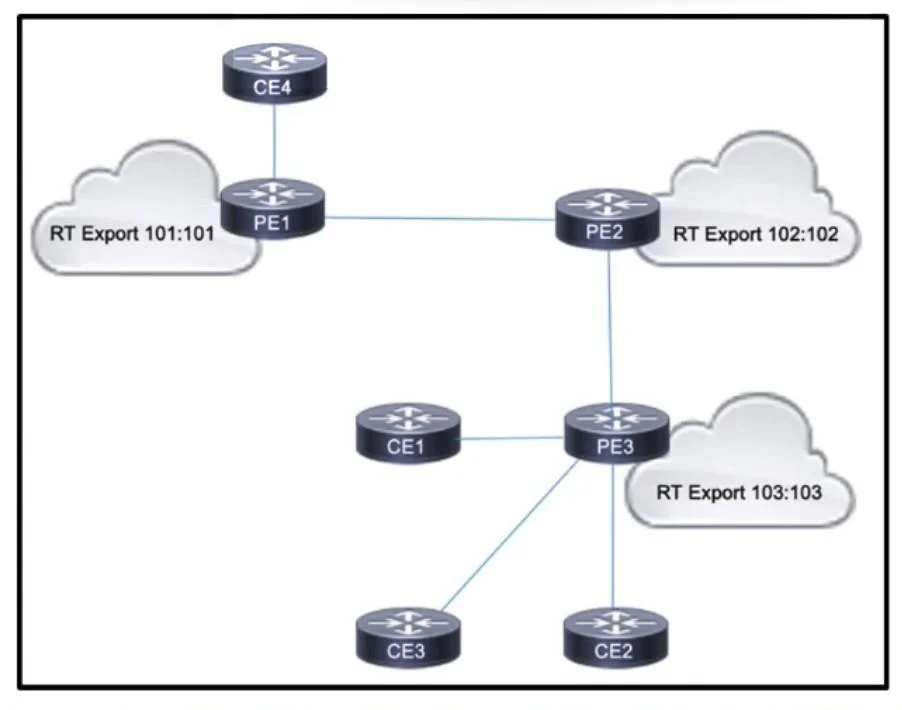
Refer to the exhibit. Routers PE1, PE2 and PE3 are in autonomous system 65516. PE1 and PE2 service CE1 to provide a variety of extranet services and connectivity between CE1 and CE4. While…
The correct answer is B. Configure PE1 and PE3 with address-family rtfilter and activate CE1 and CE4. PE1 is not importing VPN routes from PE3 because BGP RT-Constrain is in use and PE1 does not advertise or subscribe to the correct route-target filters. Enabling the address-family rtfilter on PE1 and PE3 and activating the relevant CEs allows each PE to advertise RT membership…
Question
Refer to the exhibit. Routers PE1, PE2 and PE3 are in autonomous system 65516. PE1 and PE2 service CE1 to provide a variety of extranet services and connectivity between CE1 and CE4. While troubleshooting a connectivity issue, a network engineer with noticed that PE1 is failing to populate routes from PE3 in its routing table. Which action must the engineer take to resolve the issue?
Exhibit
Options
- AConfigure PE1 with VRFs for CE1, CE2, and CE3.
- BConfigure PE1 and PE3 with address-family rtfilter and activate CE1 and CE4.
- CConfigure PE2 with route-target import 101:01 and route-target import 103:103.
- DConfigure PE2 as a route reflector.
How the community answered
(31 responses)- A6% (2)
- B68% (21)
- C19% (6)
- D6% (2)
Explanation
PE1 is not importing VPN routes from PE3 because BGP RT-Constrain is in use and PE1 does not advertise or subscribe to the correct route-target filters. Enabling the address-family rtfilter on PE1 and PE3 and activating the relevant CEs allows each PE to advertise RT membership NLRI. Once RT-Constrain is operating correctly, PE1 receives PE3’s VPNv4 updates for the required route-targets, and the missing routes populate normally.
Topics
Community Discussion
No community discussion yet for this question.