
300-515 · Question #125
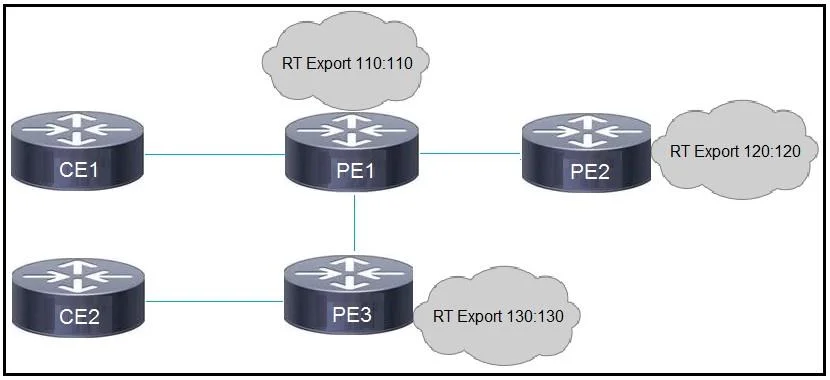
Refer to the exhibit. CE1 and CE2 are members of an enterprise that requires L3VPN services to connect the remote sites. PE2 offers internet access to both CEs. The PE-CE routing protocol is OSPF…
The correct answer is B. Configure the specific import and export targets on PE1 and PE2. PE2 advertises Internet routes with RT 120:120, but PE1/PE3’s VRFs aren’t importing that RT, so CE1/CE2 never learn the default route. To fix this, on PE1 and PE3 under their address-family ipv4 vrf … stanzas you must route-target import 120:120. And on PE2’s Internet VRF you…
Question
Refer to the exhibit. CE1 and CE2 are members of an enterprise that requires L3VPN services to connect the remote sites. PE2 offers internet access to both CEs. The PE-CE routing protocol is OSPF. Connectivity is up, and each PE can ping its connected CE, but CE1 and CE2 cannot reach the internet. Which action resolves the issue?
Exhibit
Options
- AConfigure PE1, PE2, and PE3 to be fully meshed.
- BConfigure the specific import and export targets on PE1 and PE2.
- CConfigure Loopback0 with a /24 mask as the router ID on PE1, PE2, and PE3.
- DConfigure the same route distinguisher on each PE.
How the community answered
(25 responses)- A4% (1)
- B68% (17)
- C8% (2)
- D20% (5)
Explanation
PE2 advertises Internet routes with RT 120:120, but PE1/PE3’s VRFs aren’t importing that RT, so CE1/CE2 never learn the default route. To fix this, on PE1 and PE3 under their address-family ipv4 vrf … stanzas you must route-target import 120:120. And on PE2’s Internet VRF you should likewise export 120:120 (if not already). This aligns the export RT on PE2 with the import RT on PE1/PE3 so your remote sites will receive the Internet
Topics
Community Discussion
No community discussion yet for this question.