
300-515 · Question #159
SIMULATION 3 Guidelines This is a lab item in which tasks will be performed on virtual devices. • Refer to the Tasks tab to view the tasks for this lab item. • Refer to the Topology tab to access…
The correct answer is D. The PE assigns an RD to each VRF and prepends the value to shared IPv6 routes, which allows two or more sites to use a single IP address space. Option D correctly describes the core BGP/MPLS L3VPN mechanism: the PE router prepends a Route Distinguisher (RD) to each IPv6 prefix learned from a VRF, transforming it into a unique VPNv6 address (RD + IPv6 prefix) that MP-BGP can carry across the provider backbone without…
Question
Exhibits
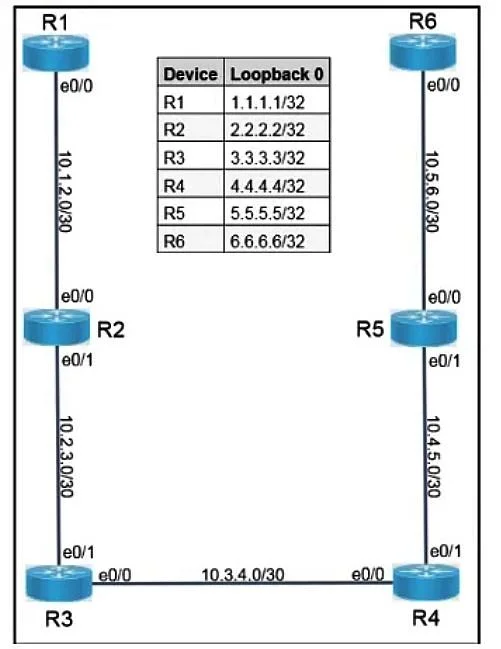
Options
- AThe CE uses NAT64 to translate the IPv6 address into a unique IPv4 address, which is sent between sites.
- BThe CE uses Unified MPLS to assign labels to IPv6 traffic only, and then it sends traffic to the PEs using those labels.
- CA DHCP server assigns an IPv4 address and an IPv6 address to each host, and the CE sends traffic from those hosts between sites.
- DThe PE assigns an RD to each VRF and prepends the value to shared IPv6 routes, which allows two or more sites to use a single IP address space.
How the community answered
(35 responses)- A3% (1)
- B11% (4)
- C6% (2)
- D80% (28)
Explanation
Option D correctly describes the core BGP/MPLS L3VPN mechanism: the PE router prepends a Route Distinguisher (RD) to each IPv6 prefix learned from a VRF, transforming it into a unique VPNv6 address (RD + IPv6 prefix) that MP-BGP can carry across the provider backbone without collision - this is precisely what enables overlapping address spaces across customer sites.
Why the distractors are wrong:
- A is wrong because NAT64 is an IPv6-to-IPv4 translation technology for internet interoperability, not a VPN transport mechanism, and the CE does not perform it here.
- B is wrong because label assignment is a PE/P router function, not a CE function, and "Unified MPLS" describes hierarchical label stacking in large networks - not per-traffic-type label assignment by CEs.
- C is wrong because DHCP simply assigns addresses to hosts; it does nothing to resolve overlapping prefixes between VPN sites, which is the actual problem being solved.
Memory tip: Think of the RD as a "VPN namespace prefix" - just like how a telephone area code makes the same local number unique across cities, the RD makes the same IPv6 route unique across different customer VRFs in the provider's MP-BGP table. PE = adds the RD; CE = knows nothing about it.
Topics
Community Discussion
No community discussion yet for this question.