
300-515 · Question #146
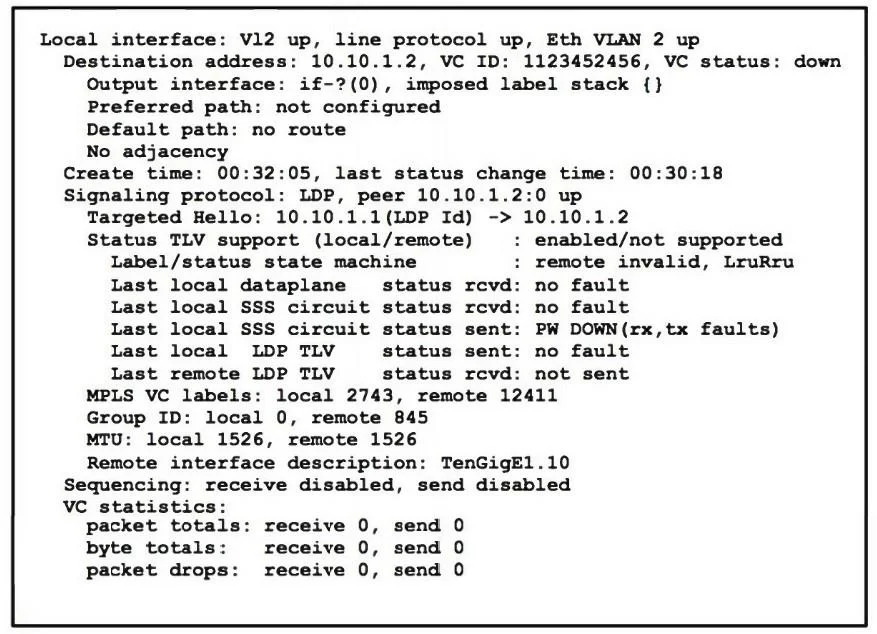
Refer to the exhibit. ISP A offers an L2VPN private connection service for business customers. The ISP network uses OSPF and BGP as the primary routing protocols. Shortly after the ISP implemented…
The correct answer is A. Configure a preferred path via MPLS-enabled routers. After migrating the core to Segment Routing, the pseudowire no longer has a transport LSP; the output shows “Preferred path: not configured” and “Default path: no route.” Configuring a preferred MPLS path (e.g., an SR/TE policy) from the local PE to the remote PE restores the…
Question
Refer to the exhibit. ISP A offers an L2VPN private connection service for business customers. The ISP network uses OSPF and BGP as the primary routing protocols. Shortly after the ISP implemented segment routing in its network, a customer’s private connection failed. Which action must the engineer take to resolve the issue?
Exhibit
Options
- AConfigure a preferred path via MPLS-enabled routers.
- BChange the remote side configuration to use xconnect mode with MPLS encapsulation.
- CAdd a static route toward the remote host.
- DAnnounce the remote router subnet into the OSPF routing domain.
How the community answered
(40 responses)- A57% (23)
- B13% (5)
- C23% (9)
- D8% (3)
Explanation
After migrating the core to Segment Routing, the pseudowire no longer has a transport LSP; the output shows “Preferred path: not configured” and “Default path: no route.” Configuring a preferred MPLS path (e.g., an SR/TE policy) from the local PE to the remote PE restores the transport label stack, bringing the L2VPN VC up.
Topics
Community Discussion
No community discussion yet for this question.