
300-510 · Question #302
Refer to the exhibit. ISP_1 uses OSPF and LDP in the backbone. Client_A and Client.B are in the same VRF_Shared. An iBGP session with address family VPNv4 is established between R6 and R14. After a…
The correct answer is A. Set the network 13.13.13.1 0.0.0.0 area 0 command under the OSPF configuration on R13. When R13 was replaced its loopback (13.13.13.1/32) was not injected into the OSPF underlay, so downstream LDP peers never learned a label for it (and MPLS paths toward Client B’s loopback likewise broke). Advertising that loopback into OSPF with a network 13.13.13.1 0.0.0.0…
Question
Refer to the exhibit. ISP_1 uses OSPF and LDP in the backbone. Client_A and Client.B are in the same VRF_Shared. An iBGP session with address family VPNv4 is established between R6 and R14. After a recent replacement of router R13, Client_A has lost its connection to Client_B. A network engineer must troubleshoot the connection from R1 to R23 via ISP_1. Which action must the engineer take to correct the problem?
Exhibit
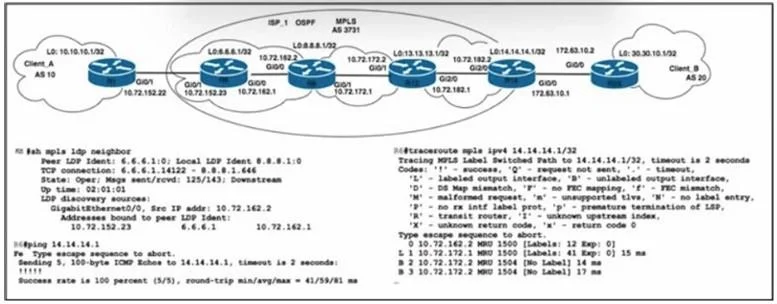
Options
- ASet the network 13.13.13.1 0.0.0.0 area 0 command under the OSPF configuration on R13.
- BSet the ip cef command under the global configuration on R6.
- CSet the next-hop-self command under the BGP configuration on R6.
- DSet the mpls label mode vrf VRF_Shared command under the global configuration on R13.
How the community answered
(16 responses)- A69% (11)
- B19% (3)
- C6% (1)
- D6% (1)
Explanation
When R13 was replaced its loopback (13.13.13.1/32) was not injected into the OSPF underlay, so downstream LDP peers never learned a label for it (and MPLS paths toward Client B’s loopback likewise broke). Advertising that loopback into OSPF with a network 13.13.13.1 0.0.0.0 area 0 statement ensures the prefix is in the RIB, gets a label via LDP and restores the end-to- end MPLS-VPN connectivity.
Topics
Community Discussion
No community discussion yet for this question.