
300-510 · Question #128
Refer to the exhibit. Customer traffic from the branch site to the hub is experiencing packet drops. The engineer verified that: - Customer traffic from the hub is able to reach the branch site…
The correct answer is D. Advertise the VPNv4 routes of the hub in CE1. Option D is correct because the asymmetric failure (branch→hub drops, but hub→branch works) points to CE1 lacking hub-site routes. PE1 has learned the hub's VPNv4 routes from PE2 via MP-BGP, but those routes are not being advertised down the PE1→CE1 (PE-CE) link - so CE1 has no…
Question
Refer to the exhibit. Customer traffic from the branch site to the hub is experiencing packet drops. The engineer verified that:
- Customer traffic from the hub is able to reach the branch site.
- The connection between PE1 and PE2 is working normally.
- Routers P1 and P2 are able to ping devices on the hub site.
Which action resolves the issue?
Exhibit
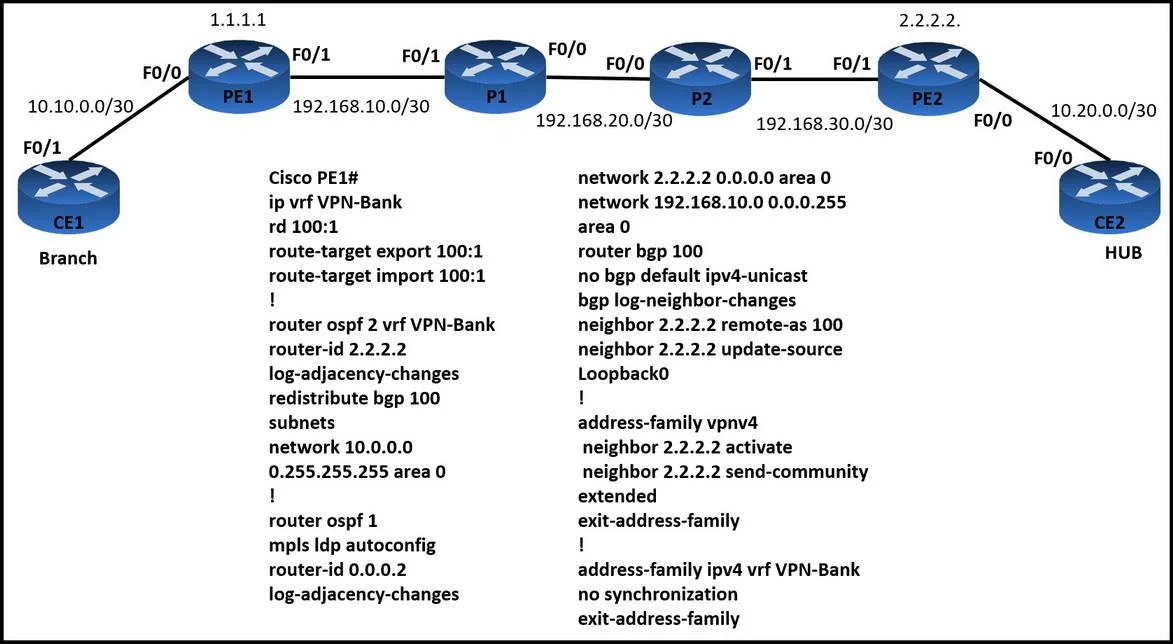
Options
- ARedistribute the CE1 OSPF routes in the PE1 VRF.
- BRedistribute the CE2 OSPF routes in the PE2 VRF.
- CAdvertise the VPNv4 routes of the branch site in CE2.
- DAdvertise the VPNv4 routes of the hub in CE1.
How the community answered
(24 responses)- A4% (1)
- B17% (4)
- C33% (8)
- D46% (11)
Explanation
Option D is correct because the asymmetric failure (branch→hub drops, but hub→branch works) points to CE1 lacking hub-site routes. PE1 has learned the hub's VPNv4 routes from PE2 via MP-BGP, but those routes are not being advertised down the PE1→CE1 (PE-CE) link - so CE1 has no path to forward branch traffic toward the hub, causing drops before the packet even enters the MPLS core.
Option A is wrong because redistributing CE1's OSPF routes into PE1's VRF affects the branch→VPN direction of route advertisement; since hub→branch already works, CE1's routes are clearly already reaching the hub - this solves a problem that doesn't exist.
Option B is wrong because if CE2's routes weren't redistributed into PE2's VRF, PE2 would never export hub routes as VPNv4, and PE1 would have nothing to forward to CE1 in the first place - but the evidence (P1/P2 can ping the hub, PE1–PE2 is healthy) suggests PE2 is exporting hub routes correctly; the bottleneck is the PE1→CE1 advertisement, not the PE2 origination.
Option C is wrong because CE2 is a customer-edge router and does not participate in VPNv4 - VPNv4 route advertisement is strictly a provider-edge (PE) function, making this option technically meaningless.
Memory tip: For asymmetric MPLS VPN drops, ask "which CE is blind?" - the CE on the sending side of the broken direction is missing routes. Branch→hub broken = CE1 (branch CE) is blind = fix the PE1→CE1 route advertisement.
Topics
Community Discussion
No community discussion yet for this question.