
300-420 · Question #382
Refer to the exhibit. An engineer with an employee ID: 1234:56:789 must design a WoL deployment for a client, and the design must ensure that the Windows PCs are responsive to the WoL magic packets…
The correct answer is C. Spanning-tree PortFast must be enabled on all interfaces where clients reside. To ensure Windows PCs are responsive to Wake-on-LAN magic packets with no delays, Spanning-tree PortFast must be enabled on their connected switch interfaces to allow immediate network connectivity upon waking up.
Question
Refer to the exhibit. An engineer with an employee ID: 1234:56:789 must design a WoL deployment for a client, and the design must ensure that the Windows PCs are responsive to the WoL magic packets with no delays when the server-side initiates the instruction. Which action must the engineer choose?
Exhibit
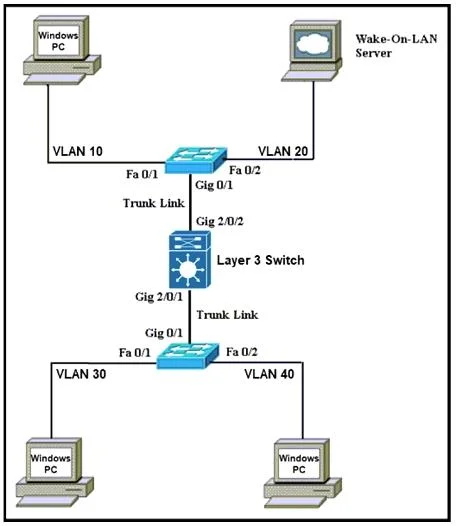
Options
- AIP-directed broadcast must be disabled on all interfaces where clients reside.
- BWoL must be enabled on the networking card and disabled in the Windows PCs BIOS.
- CSpanning-tree PortFast must be enabled on all interfaces where clients reside.
- DIP forward protocol must be disabled on all interfaces where clients reside.
How the community answered
(62 responses)- A15% (9)
- B8% (5)
- C74% (46)
- D3% (2)
Why each option
To ensure Windows PCs are responsive to Wake-on-LAN magic packets with no delays, Spanning-tree PortFast must be enabled on their connected switch interfaces to allow immediate network connectivity upon waking up.
Disabling IP-directed broadcast would prevent Wake-on-LAN magic packets from being routed across different subnets, potentially hindering the WoL functionality if the sender is not on the local subnet.
Wake-on-LAN functionality requires it to be enabled in both the networking card settings within the operating system and the system's BIOS/UEFI settings; disabling it in the BIOS would prevent WoL from working.
Spanning-tree PortFast immediately transitions a port to the forwarding state upon link-up, bypassing the normal Spanning-Tree Protocol listening and learning states. This eliminates the typical 30-50 second delay for the PC's network interface to become active, ensuring the PC is network-responsive immediately after waking up via WoL and thereby meeting the "no delays" requirement.
IP forwarding is a Layer 3 routing function, and disabling it on Layer 2 access interfaces connected to client PCs is irrelevant to Wake-on-LAN operation or network responsiveness.
Concept tested: Spanning-Tree PortFast for end-device connectivity
Source: https://www.cisco.com/c/en/us/td/docs/switches/lan/catalyst3750/software/release/12-2_55_se/configuration/guide/scg/swstp.html#wp1089304
Topics
Community Discussion
No community discussion yet for this question.