
300-420 · Question #354
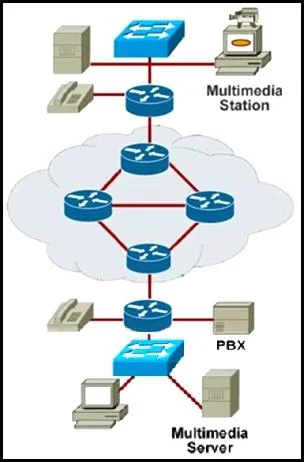
Refer to the exhibit. An engineer must ensure that the QoS design guarantees bandwidth for the applications, and an application can request a particular type of service to support its delay…
The correct answer is D. IntServ with RSVP. To guarantee bandwidth for applications and allow them to request specific delay requirements, the engineer must select the IntServ QoS model with RSVP.
Question
Refer to the exhibit. An engineer must ensure that the QoS design guarantees bandwidth for the applications, and an application can request a particular type of service to support its delay requirements. Which solution must the engineer select?
Exhibit
Options
- ADiffserv with RSVP
- BDiffserv with DSCP
- CIntServ with DSCP
- DIntServ with RSVP
How the community answered
(19 responses)- B5% (1)
- C5% (1)
- D89% (17)
Why each option
To guarantee bandwidth for applications and allow them to request specific delay requirements, the engineer must select the IntServ QoS model with RSVP.
Diffserv (Differentiated Services) is a class-based QoS model offering relative priorities, not explicit per-flow guarantees, making its combination with the IntServ-specific RSVP protocol incoherent.
Diffserv with DSCP (Differentiated Services Code Point) provides class-based QoS without explicit end-to-end guarantees or mechanisms for applications to request specific service types.
IntServ is associated with RSVP for signaling, not DSCP, which is the classification mechanism for the Diffserv model.
The Integrated Services (IntServ) QoS model is designed to provide strict, end-to-end quality-of-service guarantees for individual application flows. It utilizes the Resource Reservation Protocol (RSVP) as its signaling mechanism, allowing applications to explicitly reserve network resources like bandwidth and specify delay constraints to meet their particular service requirements.
Concept tested: IntServ QoS model with RSVP
Source: https://www.cisco.com/c/en/us/td/docs/ios/qos/configuration/guide/qos_c/qc_intgrv.html
Topics
Community Discussion
No community discussion yet for this question.