
300-420 · Question #347
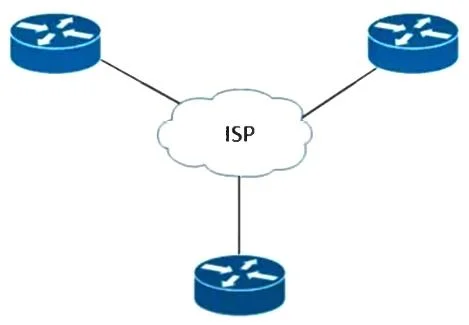
Refer to the exhibit. Due to budget constraints, a customer decided to purchase WAN routers with one LAN and one WAN interface per device. There is a requirement to connect the three sites to ensure…
The correct answer is C. single-homed hub-and-spoke. Given the constraint of WAN routers having only one LAN and one WAN interface per device for three sites, a single-homed hub-and-spoke design is the only feasible deployment. This allows each site's router to connect to a central hub through its single WAN interface, typically…
Question
Refer to the exhibit. Due to budget constraints, a customer decided to purchase WAN routers with one LAN and one WAN interface per device. There is a requirement to connect the three sites to ensure high availability without buying additional WAN links. Which design deployment must the customer choose?
Exhibit
Options
- Adual-homed full mesh
- Bsingle-homed full mesh
- Csingle-homed hub-and-spoke
- Ddual-homed hub-and-spoke
How the community answered
(22 responses)- A5% (1)
- B14% (3)
- C73% (16)
- D9% (2)
Why each option
Given the constraint of WAN routers having only one LAN and one WAN interface per device for three sites, a single-homed hub-and-spoke design is the only feasible deployment. This allows each site's router to connect to a central hub through its single WAN interface, typically via logical tunnels over a shared WAN transport, while leveraging the underlying WAN service provider's high availability.
A dual-homed full mesh would require each router to have multiple WAN interfaces (at least two for full mesh connectivity and two for dual-homing) which contradicts the "one WAN interface per device" constraint.
A single-homed full mesh would require each router to establish logical connections to every other router in the mesh, which necessitates more than one logical connection over a single physical WAN interface, and more critically, a single physical interface router cannot directly connect point-to-point to two distinct peers simultaneously without a shared medium.
With the strict constraint of only one WAN interface per router, a single-homed hub-and-spoke design is the only physically viable option for connecting three sites. Each spoke router uses its single WAN interface to connect to the central hub, which also uses its single WAN interface to connect to the spokes (via logical tunnels over a shared WAN cloud), adhering to the interface limitation while providing connectivity.
A dual-homed hub-and-spoke design inherently requires at least two WAN interfaces per site/router to provide redundancy, which directly violates the "one WAN interface per device" limitation.
Concept tested: WAN topology design with interface constraints
Topics
Community Discussion
No community discussion yet for this question.