
300-420 · Question #346
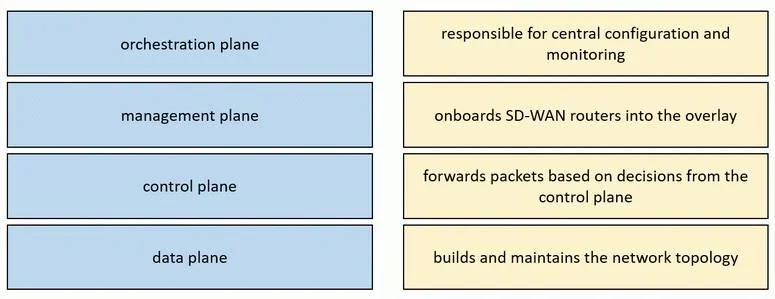
Drag and Drop Question Drag and drop the Cisco SD-WAN components from the left onto their definitions on the right. Answer:
The correct answer is orchestration plane; management plane; control plane; data plane. This question tests the understanding of the core architectural planes and their specific functions within a Cisco SD-WAN solution.
Question
Drag and Drop Question Drag and drop the Cisco SD-WAN components from the left onto their definitions on the right. Answer:
Exhibit
Answer Area
Drag items
Correct arrangement
- orchestration plane
- management plane
- control plane
- data plane
Explanation
This question tests the understanding of the core architectural planes and their specific functions within a Cisco SD-WAN solution.
Approach. The correct approach is to drag each Cisco SD-WAN plane from the left column to its corresponding definition in the right column:
- management plane should be dragged to 'responsible for central configuration and monitoring'. The vManage controller, part of the management plane, provides the centralized GUI for all configuration, monitoring, and troubleshooting tasks.
- orchestration plane should be dragged to 'onboards SD-WAN routers into the overlay'. The vBond orchestrator is responsible for authenticating and onboarding SD-WAN devices (vEdge/cEdge routers) into the SD-WAN overlay network, acting as the initial point of contact.
- control plane should be dragged to 'builds and maintains the network topology'. The vSmart controller, part of the control plane, establishes OMP (Overlay Management Protocol) peering with edge routers, distributes routing and policy information, and constructs the network topology.
- data plane should be dragged to 'forwards packets based on decisions from the control plane'. The vEdge/cEdge routers form the data plane, responsible for forwarding actual user traffic across the SD-WAN tunnels, adhering to the policies and routing decisions provided by the vSmart controller.
Common mistakes.
- common_mistake. A common mistake is confusing the roles of the management and orchestration planes, or the control and data planes. For example, incorrectly mapping 'management plane' to 'onboards SD-WAN routers' is wrong because onboarding is the specific role of the orchestration plane (vBond), while management (vManage) handles ongoing configuration and monitoring. Similarly, confusing 'control plane' with 'data plane' by assigning 'forwards packets' to control plane is incorrect, as the control plane builds the topology and makes decisions, but the data plane (edge routers) performs the actual packet forwarding.
Concept tested. Cisco SD-WAN (Viptela-based) architectural planes and their distinct functions: management, orchestration, control, and data planes. This tests the candidate's understanding of how these components interact to build, manage, and operate an SD-WAN overlay.
Topics
Community Discussion
No community discussion yet for this question.