
300-420 · Question #340
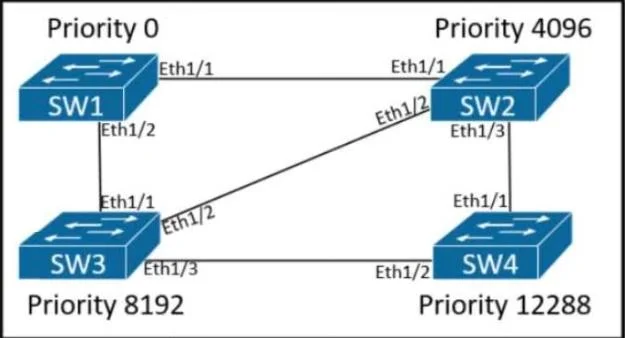
Refer to the exhibit. An engineer proposed this solution for a company that requires a loop-free, Layer 2 network design. The network will run 802.1w, and all links will be 1 Gbps. If all interfaces…
The correct answer is A. Eth1/2 on SW3 and SW4 will be in an Altn BLK state. In an 802.1w (RSTP) network with 1 Gbps links, specific ports on switches may enter an Alternate Blocking state to prevent Layer 2 loops. This occurs when a port offers a redundant path to the Root Bridge that is less optimal than the currently active Root Port.
Question
Refer to the exhibit. An engineer proposed this solution for a company that requires a loop-free, Layer 2 network design. The network will run 802.1w, and all links will be 1 Gbps. If all interfaces are up as point-to-point adjacencies, what are the expected port end states based on the design?
Exhibit
Options
- AEth1/2 on SW3 and SW4 will be in an Altn BLK state
- BEth1/3 on SW2 and SW3 will be in an Altn BLK state
- CEth1/2 on SW2 and SW3 will be in a Desg FWD state
- DEth1/1 on SW1 and SW2 will be in a Root FWD state
How the community answered
(26 responses)- A46% (12)
- B15% (4)
- C31% (8)
- D8% (2)
Why each option
In an 802.1w (RSTP) network with 1 Gbps links, specific ports on switches may enter an Alternate Blocking state to prevent Layer 2 loops. This occurs when a port offers a redundant path to the Root Bridge that is less optimal than the currently active Root Port.
The Eth1/2 ports on SW3 and SW4 are identified as Alternate Blocking ports by RSTP because they likely provide redundant paths to the Root Bridge that are not chosen as the primary Root Port, effectively preventing Layer 2 loops while maintaining network resiliency. RSTP's port role election process, considering path costs and bridge IDs, would designate these specific interfaces as Alternate ports due to a less optimal path to the root.
If Eth1/3 on SW2 and SW3 are directly connected point-to-point, only one end can be Altn BLK; the other would typically be Designated FWD.
If Eth1/2 on SW2 and SW3 are directly connected point-to-point, only one end can be Desg FWD; the other would be Root FWD or Altn BLK.
Ports on the Root Bridge (SW1) are always in a Designated Forwarding state, not a Root Forwarding state, as the Root Bridge has no path -to- itself via another bridge.
Concept tested: RSTP port states and election
Source: https://www.cisco.com/c/en/us/support/docs/lan-switching/spanning-tree-protocol/24062-146.html
Topics
Community Discussion
No community discussion yet for this question.