
300-420 · Question #333
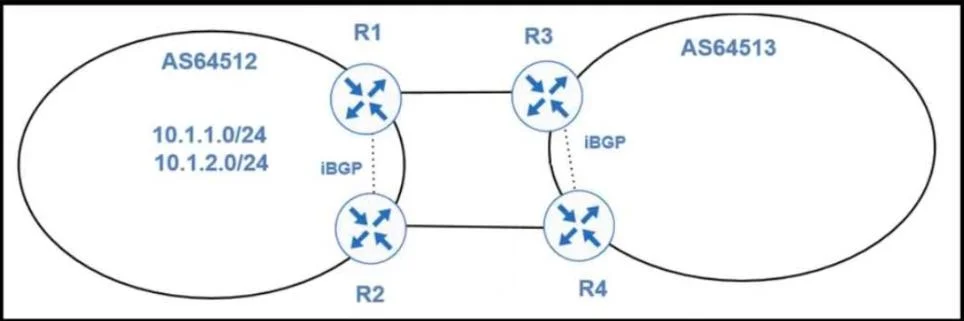
Refer to the exhibit. An architect designs a BGP policy for a customer that requires load sharing of the links that connect with the upstream service provider. The customer has these requirements…
The correct answer is B. - R1 must announce prefix 10.1.2.0/24 with the route map applied to the neighbor using set as-. To achieve inbound traffic load sharing and failover for specific prefixes, R1 and R2 must use AS-PATH prepending when advertising their respective less-preferred prefixes to the upstream service provider.
Question
Refer to the exhibit. An architect designs a BGP policy for a customer that requires load sharing of the links that connect with the upstream service provider. The customer has these requirements:
- The inbound traffic destined to network 10 1 1.0/24 must transit the
R3-R1 link, and if the link fails, all inbound traffic must transit the R4-R2 link.
- The inbound traffic destined to network 10 1 2 0/24 must transit the
R4-R2 link and if the link fails, all inbound traffic should transit the R3-R1 link. Which solution must the architect choose?
Exhibit
Options
- A
- R1 must announce prefix 10.1.1.0/24 with the route map applied to the neighbor using set as-
- B
- R1 must announce prefix 10.1.2.0/24 with the route map applied to the neighbor using set as-
- C
- R1 must announce prefix 10.1.2.0/24 with a community attribute 64513:300 and prefix
- D
- R1 must announce prefix 10.1.2.0/24 with a community attribute 64513:200 and prefix
How the community answered
(43 responses)- A9% (4)
- B74% (32)
- C14% (6)
- D2% (1)
Why each option
To achieve inbound traffic load sharing and failover for specific prefixes, R1 and R2 must use AS-PATH prepending when advertising their respective less-preferred prefixes to the upstream service provider.
The option is incomplete, stating 'set as-' without completing the command, making it technically invalid. Even if it implied AS-PATH prepending for 10.1.1.0/24 by R1, this would make R3-R1 less preferred, which contradicts the requirement for 10.1.1.0/24 to transit R3-R1.
To make inbound traffic for 10.1.2.0/24 transit R4-R2, R1 must prepend its AS-PATH when advertising 10.1.2.0/24, making the R3-R1 path less preferred for that prefix. Similarly, for 10.1.1.0/24 to transit R3-R1, R2 must prepend its AS-PATH when advertising 10.1.1.0/24, making the R4-R2 path less preferred, ensuring the upstream provider chooses the desired primary path for each prefix.
Using community attributes like 64513:300 doesn't directly dictate a path preference for inbound traffic in the way AS-PATH prepending does unless the upstream provider explicitly configured a policy to treat this community in a specific way to influence path choice. The second part of the option 'and prefix' is also incomplete.
Similar to C, using community attributes like 64513:200 without specific, universally understood meaning for path preference (other than explicit upstream agreement) is less direct than AS-PATH prepending for inbound traffic engineering. The second part of the option 'and prefix' is also incomplete.
Concept tested: BGP inbound traffic engineering, AS-PATH prepending
Source: https://www.cisco.com/c/en/us/support/docs/ip/border-gateway-protocol-bgp/20459-bgp-aspath.html
Topics
Community Discussion
No community discussion yet for this question.