
300-420 · Question #332
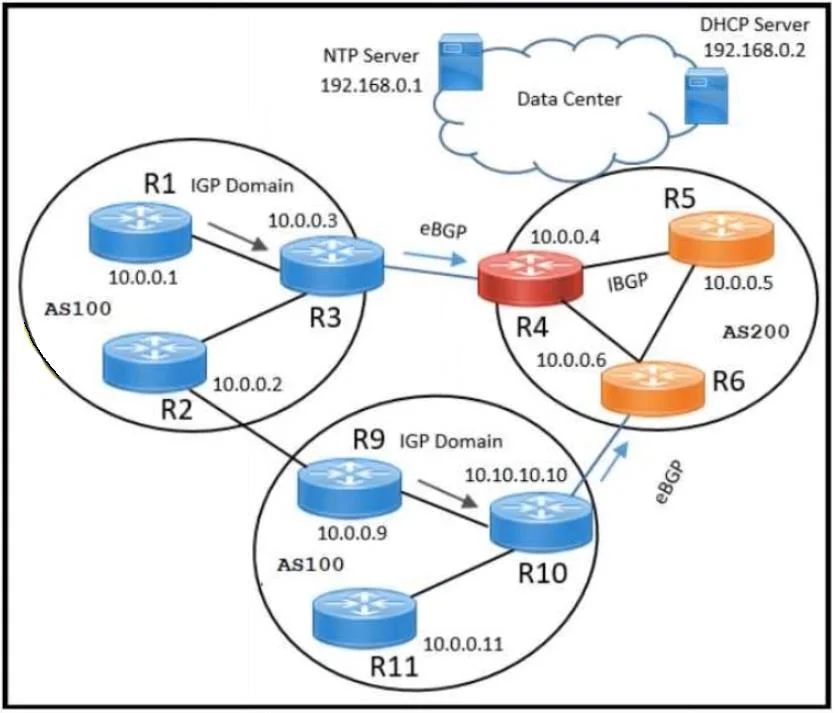
Refer to the exhibit. A network engineer working for a private service provider with an employee ID: 1234:56:789 must design a BGP solution based on: - All traffic originating from AS100 must pass…
The correct answer is B. Router R6 influences the paths of R9 and R11 to the DC with a higher AS-PATH value. To achieve specific traffic flow and failover paths for traffic from AS100 to AS300 via AS200, router R6 influences the paths of R9 and R11 to the DC with a higher AS-PATH value.
Question
Refer to the exhibit. A network engineer working for a private service provider with an employee ID: 1234:56:789 must design a BGP solution based on:
- All traffic originating from AS100 must pass through AS200 to reach
the NTP and DHCP server
- When a link failure occurs between R3 and R4, traffic must follow the
R2-R9 link to reach the NTP and DHCP server Which solution must the design include?
Exhibit
Options
- ARouters R3 and R10 advertise an IGP metric into BGP during redistribution in both directions
- BRouter R6 influences the paths of R9 and R11 to the DC with a higher AS-PATH value
- CRouters R3 and R10 advertise a lower local preference for outgoing traffic and a higher AS-PATH
- DRouter R3 applies a local preference of 200 for R1, R2, R9, and R11 routers to reach the data
How the community answered
(51 responses)- A8% (4)
- B75% (38)
- C14% (7)
- D4% (2)
Why each option
To achieve specific traffic flow and failover paths for traffic from AS100 to AS300 via AS200, router R6 influences the paths of R9 and R11 to the DC with a higher AS-PATH value.
Advertising an IGP metric into BGP during redistribution can influence BGP path selection, but it's typically less effective for influencing external AS traffic than AS-PATH or Local Preference and doesn't directly address route feedback prevention or specific failover path requirements.
By influencing R9 and R11 with a higher AS-PATH value for routes to the DC (AS300), router R6 makes paths through itself less preferred for those internal AS200 routers. This can direct traffic flow from R1/R2/R4 (connected to R9/R11) to exit AS200 via an alternative path (e.g., R10 to AS300), while traffic from R3 (connected to R6) uses the R3-R6-AS300 path. The failover would then rely on R2-R9 as a path if the R3-R4 internal link impacts R3's primary egress capability, shifting traffic to the other AS200 egress points.
Advertising a lower local preference for outgoing traffic would make R3 and R10 prefer other paths out of their own AS, which doesn't align with the requirement to route traffic from AS100 to AS300 or the failover scenario. A higher AS-PATH would make the path less preferred, but combining it with a lower local preference is confusing for the stated goal.
Applying a local preference of 200 on R3 for reaching R1, R2, R9, and R11 would influence R3's outbound traffic preferences, but it doesn't align with the global requirement for traffic from AS100 to AS300 or the specific failover through R2-R9, as local preference typically influences a router's choice of exit point from its own AS.
Concept tested: BGP path manipulation (AS-PATH prepending) for traffic engineering and failover
Source: https://www.cisco.com/c/en/us/support/docs/ip/border-gateway-protocol-bgp/20459-bgp-aspath.html
Topics
Community Discussion
No community discussion yet for this question.