
300-420 · Question #324
An engineer working for a service provider with an employee ID: 4604:68:004 prepared several designs for a traditional campus network. The design must allow the deployment of the same VLAN to any…
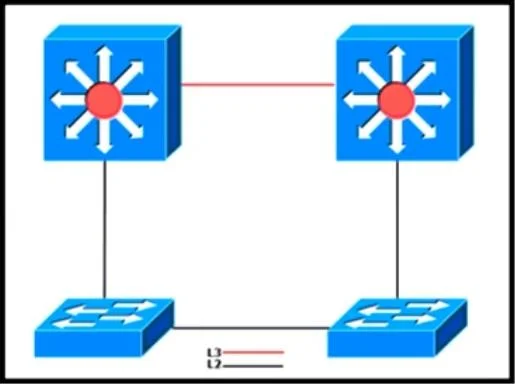
The correct answer is A. See diagram A. To allow the same VLAN on any access switch, support fast convergence, high availability, and resilience in a traditional campus, a design utilizing a collapsed core/distribution layer with active-active forwarding (e.g., VSS/StackWise Virtual) is required.
Question
An engineer working for a service provider with an employee ID: 4604:68:004 prepared several designs for a traditional campus network. The design must allow the deployment of the same VLAN to any switch at the access layer and must support:
- fast convergence
- high availability
- resilience
Which design must be selected? A. B. C. D.
Exhibits
Options
- ASee diagram A
- BSee diagram B
- CSee diagram C
- DSee diagram D
How the community answered
(25 responses)- A72% (18)
- B8% (2)
- C4% (1)
- D16% (4)
Why each option
To allow the same VLAN on any access switch, support fast convergence, high availability, and resilience in a traditional campus, a design utilizing a collapsed core/distribution layer with active-active forwarding (e.g., VSS/StackWise Virtual) is required.
Assuming Diagram A depicts a collapsed core/distribution layer employing technologies like Cisco VSS or StackWise Virtual, this design creates a single logical switch across two physical devices. This enables multi-chassis EtherChannel (MEC) to access switches, allowing the same VLAN to span all access layers with active-active forwarding, ensuring fast convergence, high availability, and resilience by eliminating Layer 2 loops.
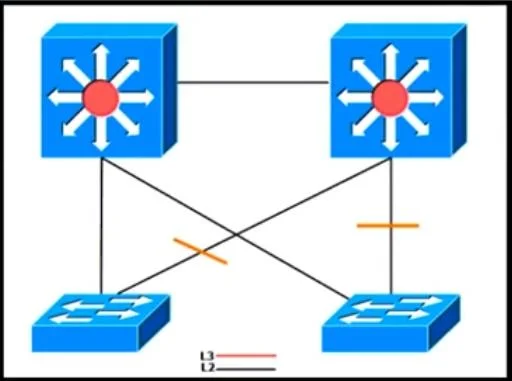
A traditional three-tier design relying solely on Spanning Tree Protocol (STP) would typically have blocked links, preventing active-active forwarding and delaying convergence, which fails to meet the fast convergence and high availability requirements.
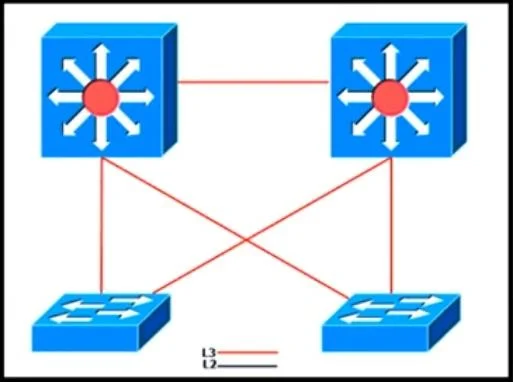
A routed access design terminates VLANs at the access layer, which prevents the deployment of the 'same VLAN to any switch at the access layer' as required by the problem statement.
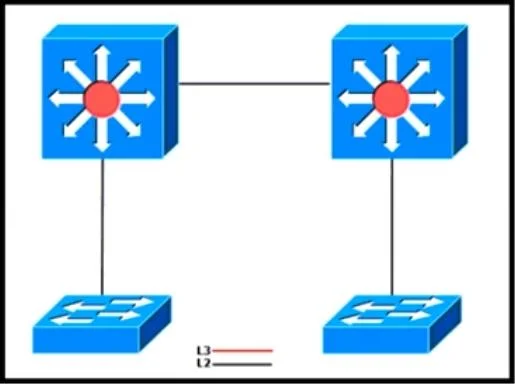
A design lacking adequate redundancy or featuring single points of failure would inherently not meet the requirements for high availability and resilience.
Concept tested: Campus network design- Layer 2 high availability
Source: https://www.cisco.com/c/en/us/products/collateral/switches/catalyst-6500-series-switches/prod_qas0900aecd8047053e_ps4006_products_q_and_a_item.html
Topics
Community Discussion
No community discussion yet for this question.