
300-420 · Question #186
Refer to the exhibit. A customer is running HSRP on the core routers. Over time the company has grown and requires more network capacity. In the current environment, some of the downstream…
The correct answer is A. Make router R2 active for half of the VLANs. When HSRP is used on core routers and some downstream interfaces are underutilized while others are overutilized, the solution must involve distributing traffic across both core routers.
Question
Refer to the exhibit. A customer is running HSRP on the core routers. Over time the company has grown and requires more network capacity. In the current environment, some of the downstream interfaces are almost fully utilized, but others are not. Which solution improves the situation?
Exhibit
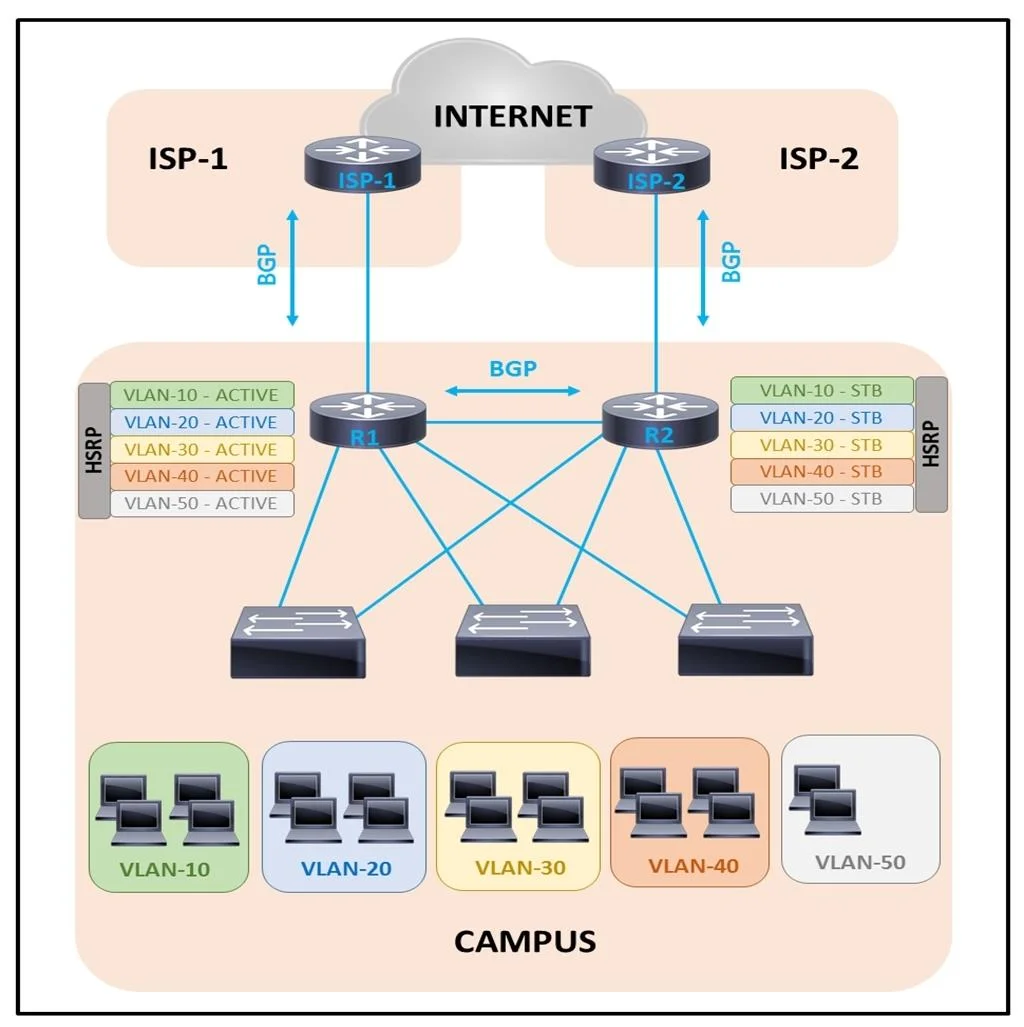
Options
- AMake router R2 active for half of the VLANs.
- BAdd more interfaces to R1 and R2.
- CConfigure port channel toward downstream switches.
- DEnable RSTP on the downstream switches.
How the community answered
(31 responses)- A77% (24)
- B13% (4)
- C6% (2)
- D3% (1)
Why each option
When HSRP is used on core routers and some downstream interfaces are underutilized while others are overutilized, the solution must involve distributing traffic across both core routers.
By configuring router R2 to be active for half of the VLANs, HSRP can operate in an active-active mode (per VLAN group), allowing both R1 and R2 to actively forward traffic for different segments. This balances the traffic load across both core routers and their downstream interfaces, improving overall network capacity and utilization.
Adding more interfaces only increases port density and does not inherently solve the traffic load imbalance issue caused by HSRP active/standby operation if not combined with a load-balancing scheme.
Configuring a port channel toward downstream switches increases bandwidth and redundancy for a single logical link but does not distribute traffic between the two HSRP core routers to balance their utilization.
Enabling RSTP on downstream switches is a Layer 2 protocol for loop prevention and faster convergence, which is unrelated to load balancing traffic across HSRP active/standby core routers.
Concept tested: HSRP load balancing with multiple groups
Source: https://www.cisco.com/c/en/us/support/docs/ip/hot-standby-router-protocol-hsrp/10583-hsrp.html
Topics
Community Discussion
No community discussion yet for this question.