
300-420 · Question #137
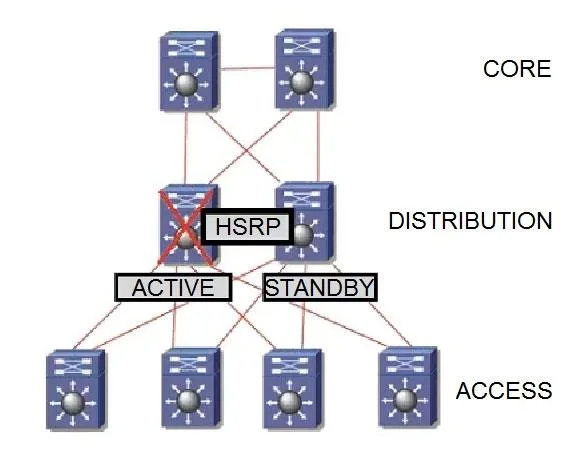
Refer to the exhibit. The distribution switches serve as the layer 3 boundary. HSRP preemption is enabled. When the primary switch comes back after a failure, traffic is initially dropped. Which…
The correct answer is B. Use the preempt delay feature on the primary HSRP device. To prevent initial traffic drops when a primary HSRP switch recovers and preempts, the preempt delay feature should be configured on the primary HSRP device, allowing it sufficient time for full convergence before taking over as active.
Question
Refer to the exhibit. The distribution switches serve as the layer 3 boundary. HSRP preemption is enabled. When the primary switch comes back after a failure, traffic is initially dropped. Which solution must be implemented to improve the design?
Exhibit
Options
- AIncrease the hello timers on both HSRP devices
- BUse the preempt delay feature on the primary HSRP device.
- CUse the preempt delay feature on the backup HSRP device
- DConfigure a higher mac-refresh interval on both HSRP devices
How the community answered
(14 responses)- A14% (2)
- B79% (11)
- D7% (1)
Why each option
To prevent initial traffic drops when a primary HSRP switch recovers and preempts, the `preempt delay` feature should be configured on the primary HSRP device, allowing it sufficient time for full convergence before taking over as active.
Increasing HSRP hello timers would only delay the detection of a failed HSRP peer and would not prevent traffic drops when the primary switch recovers and preempts prematurely.
Using the `preempt delay` feature on the primary HSRP device allows a configurable delay before preemption occurs. This delay provides the primary switch sufficient time to fully boot, establish routing adjacencies, and populate its MAC address and routing tables, thereby preventing traffic drops during its transition to the active state.
The `preempt delay` feature is relevant for the device that is doing the preemption (the primary in this case), not the backup HSRP device, as the backup does not initiate preemption.
Configuring a higher `mac-refresh` interval relates to how frequently the virtual MAC address is updated in the MAC address tables of connected switches, but it does not address the issue of the primary switch preempting before its internal routing and forwarding tables are stable.
Concept tested: HSRP preemption delay for convergence
Source: https://www.cisco.com/c/en/us/td/docs/ios-xml/ios/ipapp_fhrp/configuration/15-s/fhrp-15-s-book/fhrp-hsrp.html#GUID-E1E788C8-0B59-450C-9E48-1854581C65E7
Topics
Community Discussion
No community discussion yet for this question.