
300-370 · Question #148
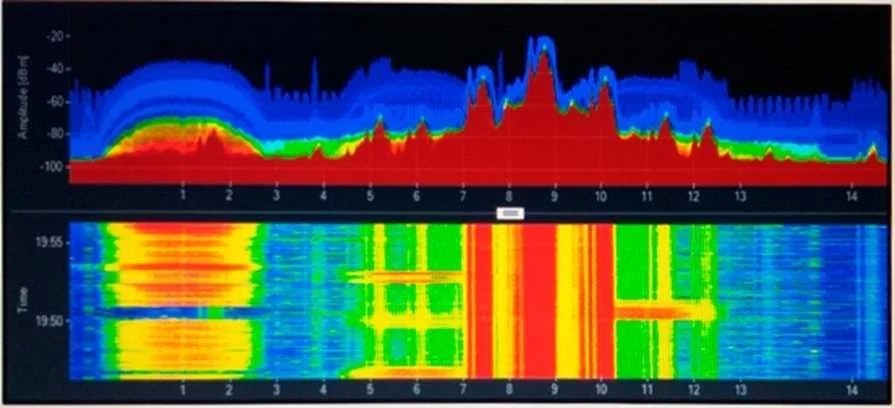
Refer to the exhibit. An engineer is troubleshooting non-802.11 interference and observes the shown output. Which interference signature is depicted?
The correct answer is B. analog video cameras. A wideband, periodically pulsing or sweeping interference signature displayed on a spectrum analyzer in the 2.4 GHz band is characteristic of analog video cameras.
Question
Refer to the exhibit. An engineer is troubleshooting non-802.11 interference and observes the shown output. Which interference signature is depicted?
Exhibit
Options
- Acordless phone
- Banalog video cameras
- Cmicrowave oven
- DFHSS Bluetooth
How the community answered
(39 responses)- A21% (8)
- B64% (25)
- C5% (2)
- D10% (4)
Why each option
A wideband, periodically pulsing or sweeping interference signature displayed on a spectrum analyzer in the 2.4 GHz band is characteristic of analog video cameras.
Cordless phones, particularly digital ones, typically exhibit different patterns such as narrower, hopping signals (FHSS) or more continuous but less wideband energy than analog video cameras.
Analog video cameras operating in the 2.4 GHz frequency band produce a distinctive wideband interference signature that often appears as a periodic, pulsing, or sweeping energy across multiple Wi-Fi channels, making it a recognizable pattern on a spectrum analyzer.
Microwave ovens generate very high-power, wideband interference that typically saturates the entire 2.4 GHz band in a very strong, broad, and often intermittent burst, which differs from the typical analog video camera pattern.
FHSS Bluetooth devices are characterized by rapid hopping across many narrow channels, appearing as numerous distinct, small, and fast-moving spikes on a spectrum analyzer, not a wide, continuous, or pulsing signature.
Concept tested: Non-802.11 interference signature recognition
Source: https://www.cisco.com/c/en/us/td/docs/wireless/controller/8-5/config-guide/b_cg85/interference_device_types.html
Topics
Community Discussion
No community discussion yet for this question.