
2V0-621 · Question #211
Refer to the Exhibit. An administrator is troubleshooting intermittent poor performance of virtual machines in a vSphere 6.x cluster. Investigating esxtop data shows that the only statistic that…
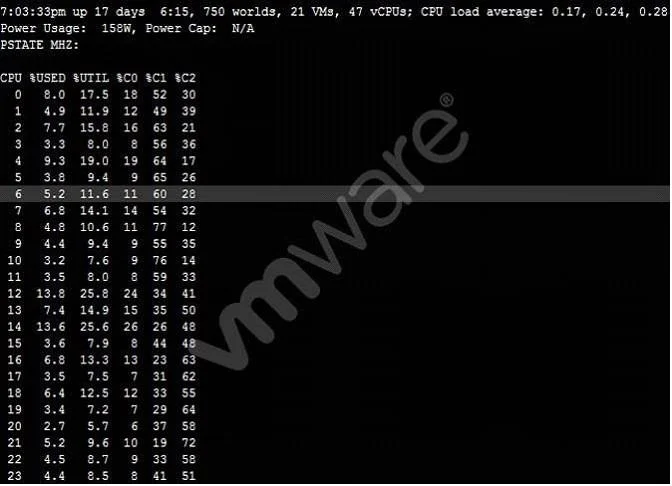
The correct answer is A. The active power policy is set to Low Power. B. The host has active Sleep States configured in the BIOS. High %CSTP in esxtop indicates vCPUs are co-stopping while waiting for peer vCPUs to be co-scheduled, a condition worsened by power management features that allow CPUs to enter sleep or throttled states, increasing scheduling latency.
Question
Refer to the Exhibit. An administrator is troubleshooting intermittent poor performance of virtual machines in a vSphere 6.x cluster. Investigating esxtop data shows that the only statistic that stands out is %CSTP as depicted in Exhibit 1:
The administrator proceeds to switch to the Power Management screen and observes the data depicted in Exhibit 2:
Based on the information in the exhibits, which two configurations are probable causes of the poor performance? (Choose two.)
Exhibits
Options
- AThe active power policy is set to Low Power.
- BThe host has active Sleep States configured in the BIOS.
- CThe active power policy is set to High Performance.
- DThe host has active Power States configured in the BIOS.
How the community answered
(29 responses)- A62% (18)
- C24% (7)
- D14% (4)
Why each option
High %CSTP in esxtop indicates vCPUs are co-stopping while waiting for peer vCPUs to be co-scheduled, a condition worsened by power management features that allow CPUs to enter sleep or throttled states, increasing scheduling latency.
The Low Power active policy enables aggressive CPU frequency scaling and allows deep sleep state transitions, causing uneven pCPU availability and forcing multi-vCPU VMs into co-stop while the hypervisor waits for all vCPUs to be simultaneously schedulable.
Active C-states (Sleep States) in BIOS allow physical CPU cores to enter deep sleep, increasing wake latency and making it difficult for the hypervisor to co-schedule all vCPUs of a VM at the same time, directly elevating %CSTP values.
The High Performance power policy disables CPU frequency scaling and prevents sleep states entirely, maximizing consistent CPU availability and reducing co-stop - it is the recommended setting to mitigate elevated %CSTP.
P-states govern CPU operating frequency and are managed by the active power policy layer; the hardware-level root cause of co-stop in this scenario is C-states (Sleep States), not generic Power States (P-states).
Concept tested: vSphere esxtop %CSTP and CPU power management root cause
Source: https://docs.vmware.com/en/VMware-vSphere/7.0/com.vmware.vsphere.resmgmt.doc/GUID-DAF6B2B7-8A0E-4E15-B8E6-5D6A7A6B9E5A.html
Topics
Community Discussion
No community discussion yet for this question.