
2V0-620 · Question #75
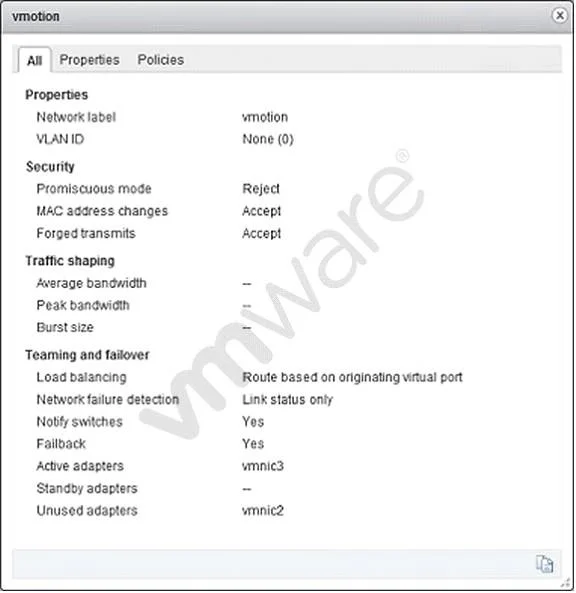
Refer to the Exhibit. An administrator has been given requirements to configure vMotion for a new virtual machine. The configuration should: Provide Network Redundancy Use VLAN 550 Be secured…
The correct answer is A. The VLAN ID must be set appropriately. B. The default values for MAC Address Changes and Forged Transmits must be altered. C. The teaming and failover adapters must be set appropriately. Meeting the vMotion requirements of VLAN 550, network redundancy, and spoof protection requires setting the VLAN ID, tightening security policies, and configuring teaming adapters appropriately.
Question
Refer to the Exhibit. An administrator has been given requirements to configure vMotion for a new virtual machine. The configuration should:
Provide Network Redundancy Use VLAN 550 Be secured against anyone trying to spoof communication The vSwitch1 configuration is shown in the Exhibit. Which three changes should be made to meet the stated requirements? (Choose three.)
Exhibit
Options
- AThe VLAN ID must be set appropriately.
- BThe default values for MAC Address Changes and Forged Transmits must be altered.
- CThe teaming and failover adapters must be set appropriately.
- DThe Traffic Shaping configuration must be altered.
- EThe Load Balancing Policy must be set appropriately.
How the community answered
(16 responses)- A50% (8)
- D13% (2)
- E38% (6)
Why each option
Meeting the vMotion requirements of VLAN 550, network redundancy, and spoof protection requires setting the VLAN ID, tightening security policies, and configuring teaming adapters appropriately.
The VLAN ID on the vMotion portgroup must be explicitly set to 550 so that traffic is tagged and isolated on the correct network segment, ensuring proper routing to and from the vMotion network.
MAC Address Changes and Forged Transmits must be changed from their default value of Accept to Reject in order to protect the vMotion portgroup against MAC spoofing and forged packet injection attacks.
Network redundancy requires that teaming and failover adapters be configured with at least two active or active/standby uplinks so that a single NIC failure does not interrupt vMotion traffic.
Traffic Shaping controls bandwidth allocation and burst rates but has no effect on VLAN assignment, security policies, or NIC redundancy.
The Load Balancing Policy governs traffic distribution across uplinks but is secondary to ensuring multiple adapters are assigned in teaming and failover, which is fully addressed by choice C.
Concept tested: vSwitch portgroup VLAN, security policy, and NIC teaming
Source: https://docs.vmware.com/en/VMware-vSphere/7.0/com.vmware.vsphere.networking.doc/GUID-3E1A4CCA-B6C7-4D9A-B25F-6D49B18BD8A9.html
Topics
Community Discussion
No community discussion yet for this question.