
200-901 · Question #94
Drag and Drop Question Drag and drop the functionalities from the left onto the correct networking devices on the right. Answer:
The correct answer is ports are different broadcast domain by default; ports can be in the same broadcast domain; uses traffic inspection to make routing decisions; blocks networks traffic by default. The question tests the fundamental characteristics and functions of common networking devices: Firewalls, Load Balancers, Routers, and Switches, requiring the test-taker to correctly associate their primary roles with given descriptions.
Question
Exhibit
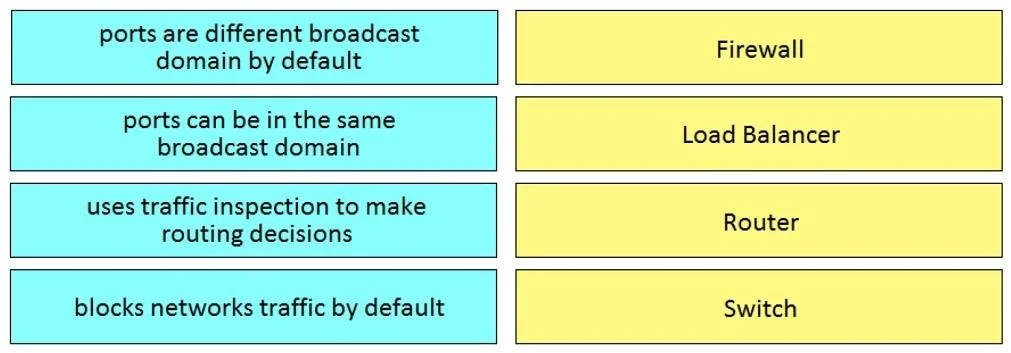
Answer Area
Drag items
Correct arrangement
- ports are different broadcast domain by default
- ports can be in the same broadcast domain
- uses traffic inspection to make routing decisions
- blocks networks traffic by default
Explanation
The question tests the fundamental characteristics and functions of common networking devices: Firewalls, Load Balancers, Routers, and Switches, requiring the test-taker to correctly associate their primary roles with given descriptions.
Approach. The correct interaction is to drag each functionality description from the left column and drop it onto the corresponding networking device in the right column.
-
Firewall should be matched with 'blocks networks traffic by default'.
- Reasoning: A firewall's primary purpose is to enforce security policies by filtering incoming and outgoing network traffic. Most firewalls operate on a 'deny all' or 'block by default' principle, meaning traffic is blocked unless explicitly permitted by a rule.
-
Load Balancer should be matched with 'uses traffic inspection to make routing decisions'.
- Reasoning: While 'routing decisions' might typically refer to IP routing, advanced load balancers (especially Layer 7) perform deep packet inspection (DPI) on traffic (e.g., HTTP headers, URL paths, cookies) to make intelligent decisions about which backend server should receive the request. This is a form of 'traffic inspection' to 'direct traffic' (which can be broadly considered a routing-like decision within a server farm).
-
Router should be matched with 'ports are different broadcast domain by default'.
- Reasoning: Routers operate at Layer 3 (Network Layer) and connect different IP networks. Each port (interface) on a router typically connects to a separate network segment, which by definition means it's a separate broadcast domain. A router's function is to forward packets between these different broadcast domains.
-
Switch should be matched with 'ports can be in the same broadcast domain'.
- Reasoning: Switches operate at Layer 2 (Data Link Layer) and connect devices within the same local area network (LAN). By default, all ports on a simple switch (without VLANs configured) belong to the same broadcast domain. Devices connected to these ports can communicate directly without needing a router.
Common mistakes.
- common_mistake. Common mistakes include:
- Matching 'ports are different broadcast domain by default' to a Switch: A switch's default behavior is to have all ports in the same broadcast domain. While VLANs can create multiple broadcast domains on a switch, the default state or the general characteristic of a switch (compared to a router) is shared broadcast domains.
- Matching 'ports can be in the same broadcast domain' to a Router: A router's ports are always in different broadcast domains by default, as its job is to connect distinct networks.
- Matching 'uses traffic inspection to make routing decisions' to Firewall: Firewalls use traffic inspection, but primarily for security decisions (allow/deny, detect threats), not for general routing decisions to find a path between networks or distribute load.
- Matching 'blocks networks traffic by default' to Load Balancer or Switch: Neither a Load Balancer nor a Switch has a primary function of blocking traffic by default for security purposes. They are designed to forward traffic (or distribute it).
Concept tested. Fundamental understanding of common networking devices (Firewall, Load Balancer, Router, Switch) and their core functionalities, including their operational layers, broadcast domain behavior, and primary roles in traffic management and security.
Topics
Community Discussion
No community discussion yet for this question.