
200-901 · Question #562
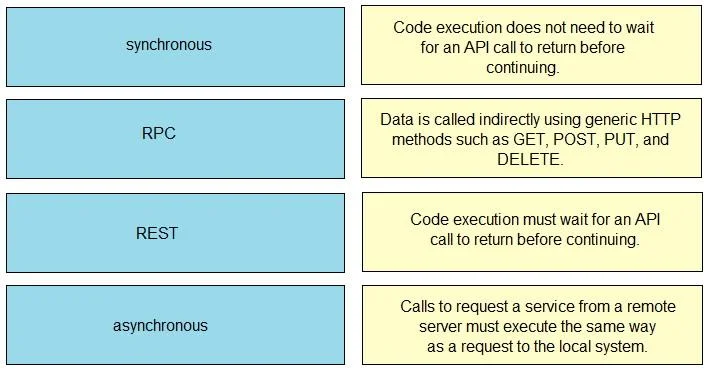
Drag and Drop Question Drag and drop the common API styles from the left onto the requirement on the right. Answer:
The correct answer is asynchronous; REST; synchronous; RPC. The question tests the understanding of common API styles-synchronous, asynchronous, REST, and RPC-and their defining characteristics through a drag-and-drop interface.
Question
Drag and Drop Question Drag and drop the common API styles from the left onto the requirement on the right. Answer:
Exhibit
Answer Area
Drag items
Correct arrangement
- asynchronous
- REST
- synchronous
- RPC
Explanation
The question tests the understanding of common API styles-synchronous, asynchronous, REST, and RPC-and their defining characteristics through a drag-and-drop interface.
Approach. To correctly answer, each API style from the left must be dragged to its corresponding description on the right, matching based on their definitions:
- Drag 'asynchronous' to 'Code execution does not need to wait for an API call to return before continuing.' - Asynchronous operations allow the calling program to continue processing without waiting for the API call to complete.
- Drag 'REST' to 'Data is called indirectly using generic HTTP methods such as GET, POST, PUT, and DELETE.' - RESTful APIs are resource-based and leverage standard HTTP methods (verbs) to perform operations on these resources.
- Drag 'synchronous' to 'Code execution must wait for an API call to return before continuing.' - Synchronous operations block the calling program until the API call has finished and returned a result.
- Drag 'RPC' to 'Calls to request a service from a remote server must execute the same way as a request to the local system.' - Remote Procedure Calls (RPC) aim to make remote service invocation appear as if a local function or procedure is being called, abstracting the network communication.
Common mistakes.
- common_mistake. A common mistake is confusing synchronous and asynchronous operations. For instance, dragging 'synchronous' to the description of 'asynchronous' (and vice versa) would be incorrect because it misunderstands whether the calling code waits for the API response. Another mistake could be mixing up REST and RPC, such as associating 'RPC' with HTTP methods; while RPC can use HTTP as a transport, its fundamental paradigm is invoking procedures, not manipulating resources via standard HTTP verbs as REST does. Incorrectly matching any of these would demonstrate a lack of understanding of the core principles of API communication patterns and architectural styles.
Concept tested. The fundamental concepts of API communication styles and architectural patterns, specifically distinguishing between synchronous and asynchronous processing, and understanding the core principles and differences between REST (Representational State Transfer) and RPC (Remote Procedure Call) API designs.
Topics
Community Discussion
No community discussion yet for this question.