
200-301 · Question #897
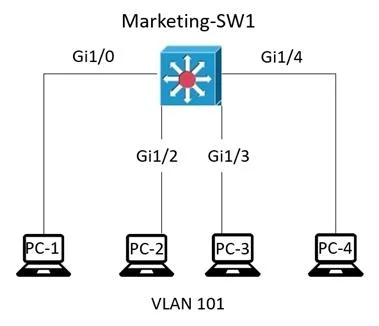
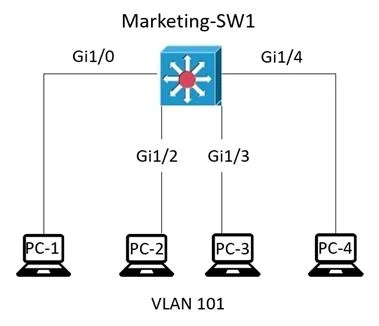
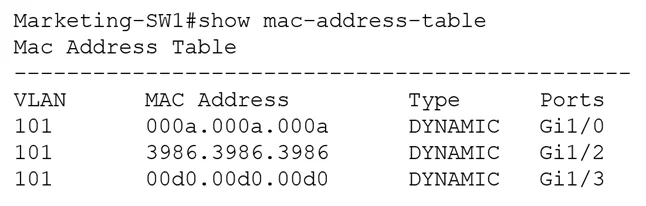
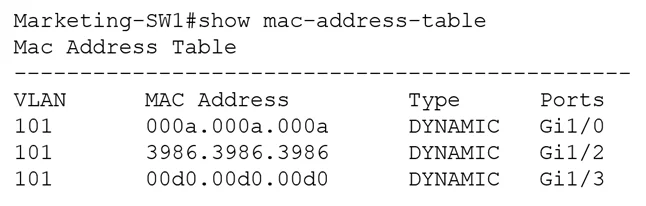
Refer to the exhibit. The entire Marketing-SW1 MAC address table is shown here: What does the switch do when PC-4 sends a frame to PC-1?
The correct answer is C. It inserts the source MAC address and port into the table and forwards the frame to PC-1. When a switch receives a frame from an unknown source MAC address, it adds that MAC and its incoming port to its table, then forwards the frame based on the destination MAC lookup.
Question
Exhibits
Options
- AIt performs a lookup in the MAC address table and discards the frame due to a missing entry.
- BIt maps the Layer 2 MAC address to the Layer 3 IP address and forwards the frame.
- CIt inserts the source MAC address and port into the table and forwards the frame to PC-1.
- DIt floods the frame out of all ports except on the port where PC-1 is connected.
How the community answered
(31 responses)- A6% (2)
- B13% (4)
- C77% (24)
- D3% (1)
Why each option
When a switch receives a frame from an unknown source MAC address, it adds that MAC and its incoming port to its table, then forwards the frame based on the destination MAC lookup.
The switch would not discard the frame because PC-1, the destination, is present in the MAC address table, and it always learns the source MAC, even if the destination is initially unknown.
Switches operate at Layer 2 and forward frames based on MAC addresses. They do not map Layer 2 MAC addresses to Layer 3 IP addresses for forwarding decisions.
When Marketing-SW1 receives a frame from PC-4 (whose MAC address is not currently in the table), it first learns PC-4's MAC address and the interface it arrived on, inserting this information into its MAC address table. The switch then looks up the destination MAC address, PC-1, finds it associated with port Fa0/1, and forwards the frame directly out of Fa0/1 to PC-1.
The switch will not flood the frame because the destination MAC address for PC-1 is known in its MAC address table, allowing for direct unicast forwarding. Flooding only occurs for unknown unicast, broadcast, or multicast traffic.
Concept tested: Switch MAC address learning and forwarding
Source: https://www.cisco.com/c/en/us/td/docs/switches/lan/catalyst6500/ios/12-2SXF/configuration/guide/swcg_s/mac_addr.html
Topics
Community Discussion
No community discussion yet for this question.