
200-301 · Question #435
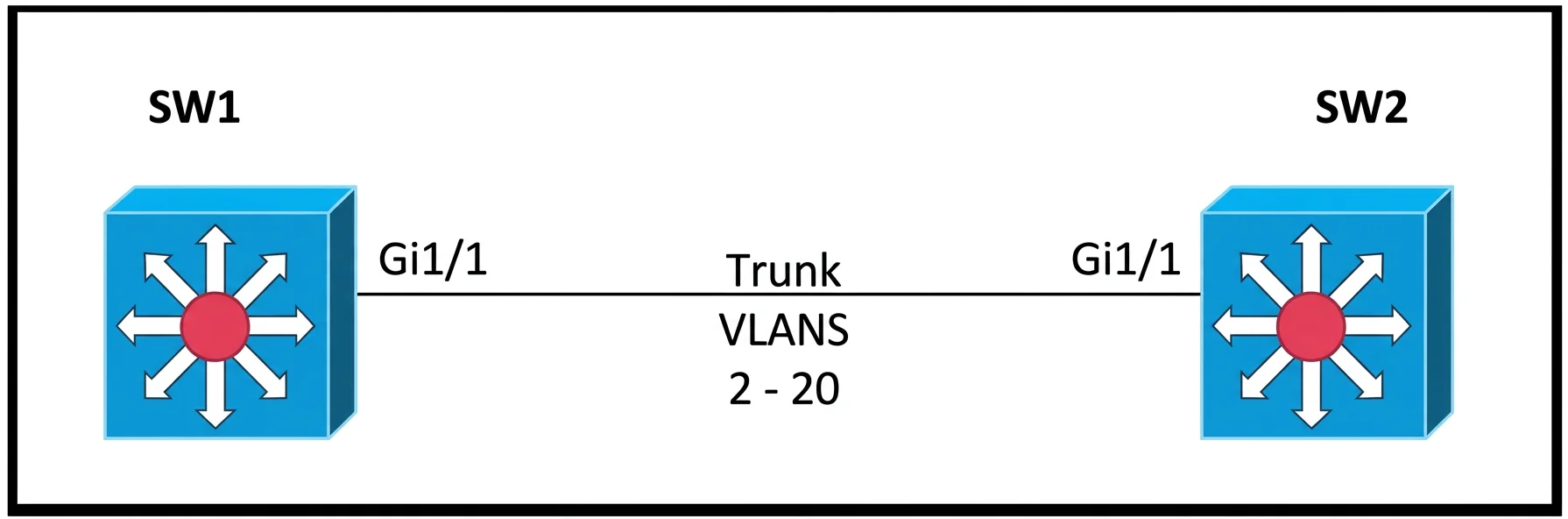
Refer to the exhibit. Which command must be executed for Gi1.1 on SW1 to become a trunk port if Gi1/1 on SW2 is configured in desirable or trunk mode?
The correct answer is C. switchport mode dynamic auto. To form a trunk link with a neighbor port already configured in desirable or trunk mode, a switch port can be configured for dynamic auto negotiation.
Question
Refer to the exhibit. Which command must be executed for Gi1.1 on SW1 to become a trunk port if Gi1/1 on SW2 is configured in desirable or trunk mode?
Exhibits
Options
- Aswitchport mode trunk
- Bswitchport mode dot1-tunnel
- Cswitchport mode dynamic auto
- Dswitchport mode dynamic desirable
How the community answered
(30 responses)- A17% (5)
- B3% (1)
- C73% (22)
- D7% (2)
Why each option
To form a trunk link with a neighbor port already configured in desirable or trunk mode, a switch port can be configured for dynamic auto negotiation.
While `switchport mode trunk` would force a trunk, the question asks for a command given SW2 is dynamic/trunk, implying DTP negotiation where `dynamic auto` is a suitable response.
`switchport mode dot1-tunnel` configures a QinQ tunnel port, which is not for standard 802.1Q trunking.
When the neighboring switch port (SW2 Gi1/1) is configured in either `switchport mode dynamic desirable` or `switchport mode trunk`, configuring SW1 Gi1/1 with `switchport mode dynamic auto` will successfully negotiate and establish a trunk link. The `dynamic auto` mode makes the port willing to convert to a trunk link if the adjacent port actively desires or forces a trunk.
`switchport mode dynamic desirable` would also result in a trunk, but `dynamic auto` is also a valid and often preferred passive option when the other side is already actively attempting to form a trunk or forced into trunk mode.
Concept tested: DTP Trunk Negotiation
Source: https://www.cisco.com/c/en/us/support/docs/lan-switching/vlans/10313-25.html
Topics
Community Discussion
No community discussion yet for this question.