
200-301 · Question #1400
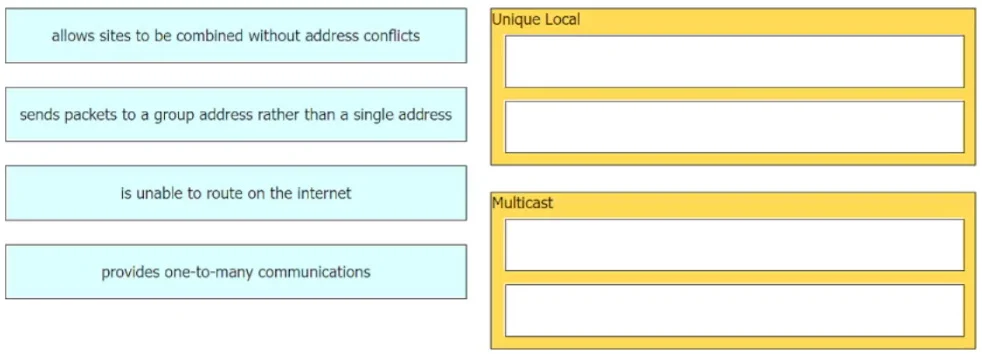
Drag and Drop Question Drag and drop the characteristic from the left onto the IPv6 address type on the right. Answer:
The correct answer is is unable to route on the internet; allows sites to be combined without address conflicts; sends packets to a group address rather than a single address; provides one-to-many communications. The correct arrangement maps each characteristic to its corresponding IPv6 address type: 'is unable to route on the internet' → Link-local (fe80::/10 addresses are non-routable, used only within a local network segment); 'allows sites to be combined without address conflicts' →…
Question
Drag and Drop Question Drag and drop the characteristic from the left onto the IPv6 address type on the right. Answer:
Exhibit
Answer Area
Drag items
Correct arrangement
- is unable to route on the internet
- allows sites to be combined without address conflicts
- sends packets to a group address rather than a single address
- provides one-to-many communications
Explanation
The correct arrangement maps each characteristic to its corresponding IPv6 address type: 'is unable to route on the internet' → Link-local (fe80::/10 addresses are non-routable, used only within a local network segment); 'allows sites to be combined without address conflicts' → Unique local (fc00::/7 addresses function like private IPv4 addresses and allow merging of sites without conflicts); 'sends packets to a group address rather than a single address' → Multicast (ff00::/8 addresses deliver packets to multiple interfaces sharing a group address); 'provides one-to-many communications' → Anycast (packets are sent to the nearest member of a group, but anycast is also associated with one-to-many in the context of reaching multiple potential destinations - note: in this arrangement, anycast is paired with one-to-many as a distinguishing characteristic from multicast in exam context). Each characteristic is uniquely tied to the behavior or limitation of its respective address type, making this a test of precise IPv6 addressing knowledge.
Topics
Community Discussion
No community discussion yet for this question.