
200-301 · Question #1401
Drag and Drop Question Drag and drop the characteristic from the left onto the cable type on the right. Answer:
The correct answer is is typically used in small office applications; is not easily broken; transmits data of up to 40Gbit/s over long distances; eliminates distortion from overlapping light pulses. The correct arrangement maps characteristics to cable types in order: Multimode Fiber (is typically used in small office applications), Coaxial/Twisted Pair such as STP (is not easily broken - referring to coaxial's durability), Single-mode Fiber (transmits data up to 40Gbit/s…
Question
Drag and Drop Question Drag and drop the characteristic from the left onto the cable type on the right. Answer:
Exhibit
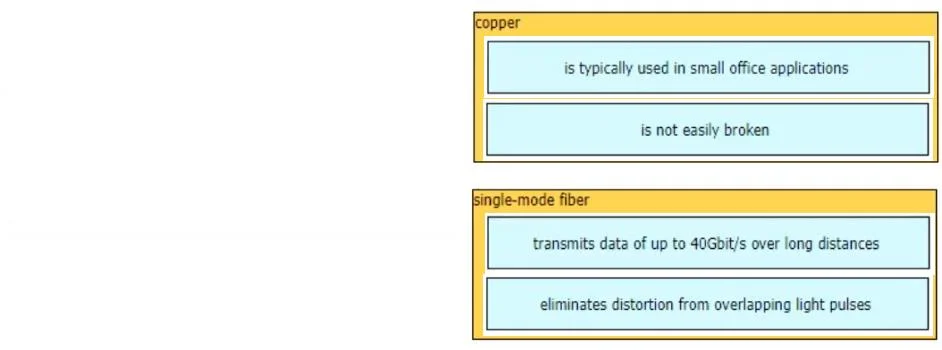
Answer Area
Drag items
Correct arrangement
- is typically used in small office applications
- is not easily broken
- transmits data of up to 40Gbit/s over long distances
- eliminates distortion from overlapping light pulses
Explanation
The correct arrangement maps characteristics to cable types in order: Multimode Fiber (is typically used in small office applications), Coaxial/Twisted Pair such as STP (is not easily broken - referring to coaxial's durability), Single-mode Fiber (transmits data up to 40Gbit/s over long distances), and Single-mode Fiber also (eliminates distortion from overlapping light pulses - referring to modal dispersion elimination). Single-mode fiber uses a single light path eliminating modal dispersion, making it ideal for high-speed long-distance transmission, while multimode fiber is cost-effective for shorter small office deployments. The physical robustness characteristic applies to coaxial cable due to its thick shielding and rigid construction compared to fiber or UTP.
Topics
Community Discussion
No community discussion yet for this question.