
200-301 · Question #1641
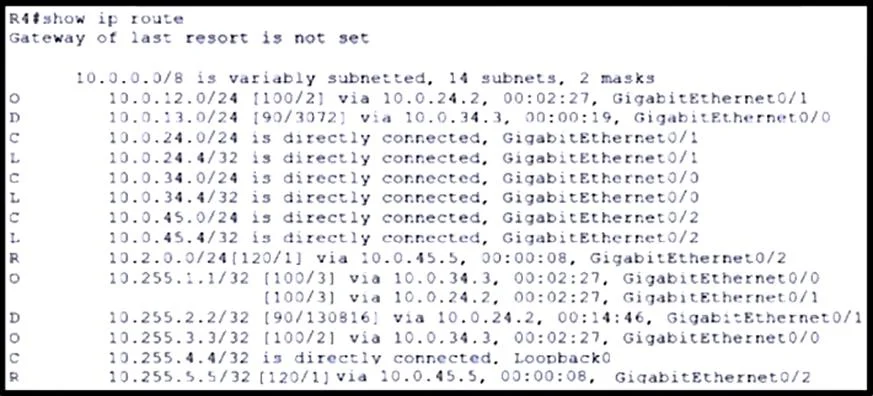
Refer to the exhibit. Of the routes learned with dynamic routing protocols, which has the least preferred metric?
The correct answer is A. EIGRP. To understand why, we need to look at the metric value for each dynamic routing protocol. In a Cisco routing table, the metric is the second number inside the brackets: [Administrative Distance The routing table displays three dynamic protocols. Here is how their metrics…
Question
Exhibits
Options
- AEIGRP
- BRIP
- CLocal
- DOSPF
How the community answered
(15 responses)- A93% (14)
- B7% (1)
Explanation
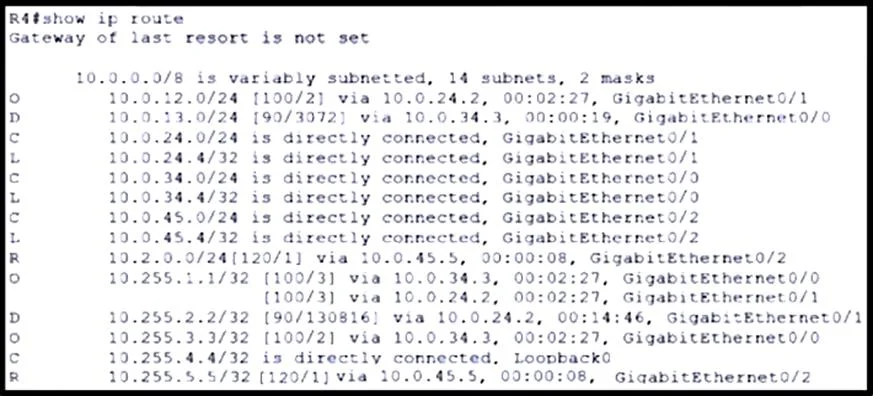
To understand why, we need to look at the metric value for each dynamic routing protocol. In a Cisco routing table, the metric is the second number inside the brackets: [Administrative Distance The routing table displays three dynamic protocols. Here is how their metrics compare: EIGRP (Code: D): The routes for 10.0.13.0/24 and 10.255.2.2/32 show metrics of 3072 and 130816. EIGRP uses a composite metric (bandwidth and delay), resulting in very high numerical RIP (Code: R): The routes for 10.2.0.0/24 and 10.255.5.5/32 show a metric of 1. RIP uses hop count as its metric. OSPF (Code: O): The routes for 10.0.12.0/24 and others show metrics of 2 or 3. OSPF uses "cost" based on interface bandwidth. In the world of routing, a lower metric is more preferred. Therefore: 1. RIP (1) and OSPF (2-3) have very low numerical values and are highly preferred by their respective algorithms. 2. EIGRP (3072 - 130816) has the highest numerical value in this table. Because EIGRP's calculated metric is the highest number among the protocols shown, it is technically the least preferred metric numerically when compared to the simple hop counts of RIP or the low costs of OSPF.
Topics
Community Discussion
No community discussion yet for this question.