
200-301 · Question #1538
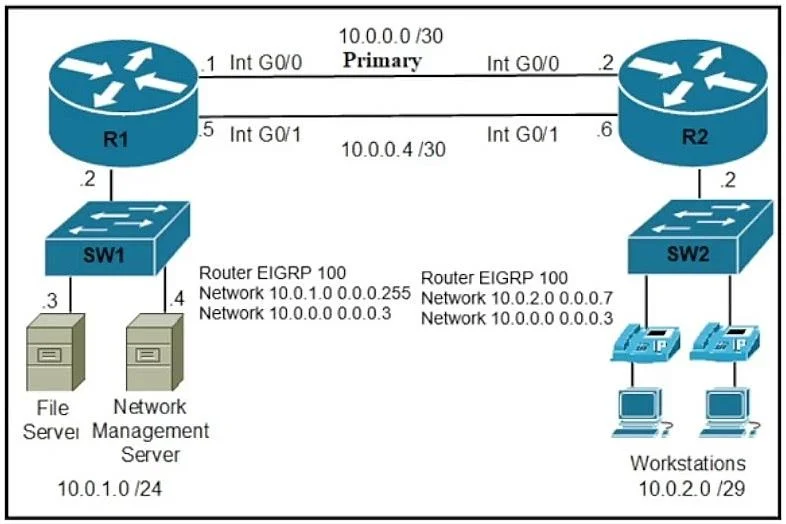
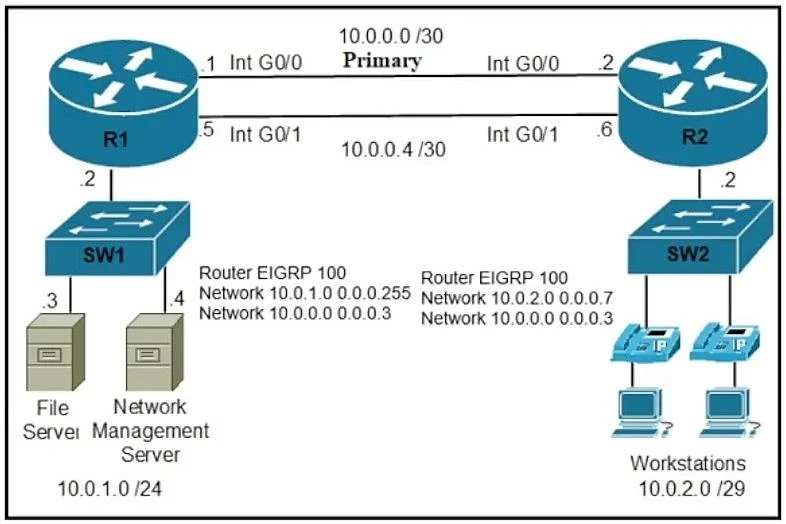
Refer to the exhibit. A secondary route is required on router R1 to pass traffic to the LAN network on R2 if the primary link fails. Which command must be entered to configure the router?
The correct answer is D. ip route 10.0.2.0 255.255.255.248 10.0.0.6 91. To configure a secondary route on R1 that is only used if the primary link to R2 fails, a static route with a higher administrative distance (floating static route) is required.
Question
Exhibits
Options
- Aip route 10.0.2.0 255.255.255.240 10.0.0.7 92
- Bip route 10.0.2.0 255.255.255.240 10.0.0.6 91
- Cip route 10.0.2.0 255.255.255.248 null0 93
- Dip route 10.0.2.0 255.255.255.248 10.0.0.6 91
How the community answered
(28 responses)- A7% (2)
- B4% (1)
- C14% (4)
- D75% (21)
Why each option
To configure a secondary route on R1 that is only used if the primary link to R2 fails, a static route with a higher administrative distance (floating static route) is required.
While the administrative distance of 92 suggests a floating static route, the next-hop IP address 10.0.0.7 is incorrect or the subnet mask 255.255.255.240 does not match the target LAN network's CIDR as implied by the correct answer.
The subnet mask 255.255.255.240 is incorrect for the 10.0.2.0 LAN network, as the correct answer uses 255.255.255.248.
Using 'null0' as the next hop blackholes traffic to the destination network, which is unsuitable for passing traffic to a live LAN network on R2.
Option D correctly specifies a floating static route to the 10.0.2.0/29 network on R2, using 10.0.0.6 as the next-hop IP address. The administrative distance of 91 ensures this route is only used if a primary route with a lower administrative distance, such as a directly connected route or another static route with a lower AD, becomes unavailable.
Concept tested: Floating static routes configuration
Source: https://www.cisco.com/c/en/us/td/docs/ios-xml/ios/iproute_static/configuration/xe-3s/irs-xe-3s-book/irs-static-float.html
Topics
Community Discussion
No community discussion yet for this question.