
200-301 · Question #1354
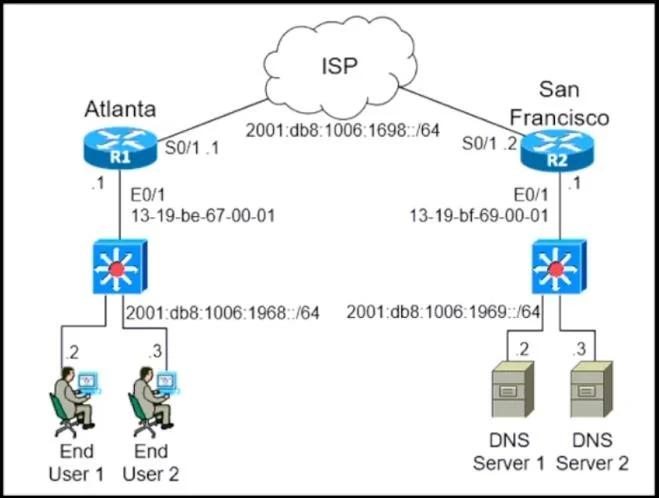
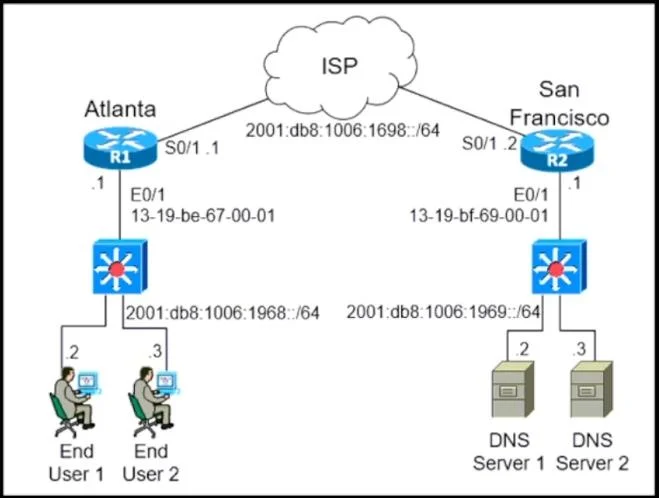
Refer to the exhibit. The IPv6 address for the LAN segment on router R1 must be configured using the EUI-64 format. When configured which Ipv6 address Is produced by the router?
The correct answer is B. 2001:db8:1006:1968:1119:BEFF:FE67:1. The question requires determining the IPv6 address generated using the EUI-64 format from an unspecified router MAC address.
Question
Refer to the exhibit. The IPv6 address for the LAN segment on router R1 must be configured using the EUI-64 format. When configured which Ipv6 address Is produced by the router?
Exhibits
Options
- A2001:db8:1006:1968:4564:877F:FE99:1
- B2001:db8:1006:1968:1119:BEFF:FE67:1
- C2001:db8:1006:1968:1130:ABFF:FECC:1
- D2001:db8:1006:1968:12D8:BAFE:FF01:1
How the community answered
(29 responses)- A14% (4)
- B79% (23)
- C3% (1)
- D3% (1)
Why each option
The question requires determining the IPv6 address generated using the EUI-64 format from an unspecified router MAC address.
This address would be generated from a different MAC address after applying the EUI-64 rules, specifically if the first byte of the MAC address before the 7th bit flip was 47h.
An IPv6 EUI-64 interface ID is formed by splitting a 48-bit MAC address in half, inserting FFFE in the middle, and then flipping the 7th bit (the Universal/Local bit) of the first byte of the original MAC address. Assuming R1's MAC address is 13:19:BE:67:00:01, applying EUI-64 would result in an interface ID of 1119:BEFF:FE67:0001, which, when appended to the given prefix 2001:db8:1006:1968::/64, forms the complete IPv6 address 2001:db8:1006:1968:1119:BEFF:FE67:1.
This address would be generated from a different MAC address and different EUI-64 segment than the one corresponding to the correct answer.
This address would be generated from a different MAC address after applying the EUI-64 rules, specifically if the first byte of the MAC address before the 7th bit flip was 10h.
Concept tested: IPv6 EUI-64 Address Generation
Source: https://www.cisco.com/c/en/us/td/docs/ios-xml/ios/ipv6_basic_connectivity/configuration/xe-3s/ipv6-basic-connectivity-xe-3s-book/ip6-eui64.html
Topics
Community Discussion
No community discussion yet for this question.