
200-301 · Question #1317
Drag and Drop Question Drag and drop the characteristic from the left onto the IPv6 address type on the right. Answer:
The correct answer is 2000:0962:6dee:8c78:93b8:c429:78d:1; fc00:9e81:2346:4929:7fec:34e9:7b8c:3; fe80:27bb:1ef9:6b3d:b347:686f:f3b7:7; ff00:0a7c:cf36:cd7c:6dad:44fa:c11c:12. IPv6 address types are identified by their leading bits/prefixes: Global Unicast addresses begin with 2000::/3 (range 2000:: to 3FFF::), making '2000:...' the Global Unicast address. Unique Local addresses use the FC00::/7 prefix (FC or FD), making 'fc00:...' the Unique Local…
Question
Exhibit
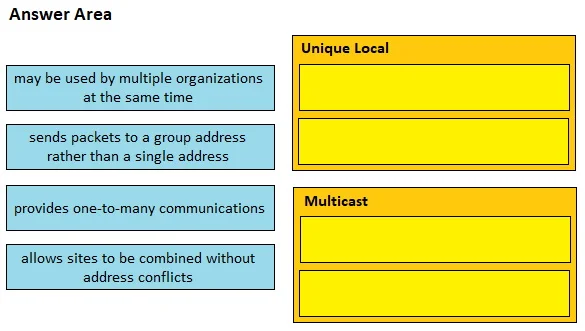
Answer Area
Drag items
Correct arrangement
- 2000:0962:6dee:8c78:93b8:c429:78d:1
- fc00:9e81:2346:4929:7fec:34e9:7b8c:3
- fe80:27bb:1ef9:6b3d:b347:686f:f3b7:7
- ff00:0a7c:cf36:cd7c:6dad:44fa:c11c:12
Explanation
IPv6 address types are identified by their leading bits/prefixes: Global Unicast addresses begin with 2000::/3 (range 2000:: to 3FFF::), making '2000:...' the Global Unicast address. Unique Local addresses use the FC00::/7 prefix (FC or FD), making 'fc00:...' the Unique Local address. Link-Local addresses always begin with FE80::/10, making 'fe80:...' the Link-Local address. Multicast addresses begin with FF00::/8, making 'ff00:...' the Multicast address. The correct arrangement maps each address to its type based on these well-defined prefix ranges.
Topics
Community Discussion
No community discussion yet for this question.