
200-301 · Question #1316
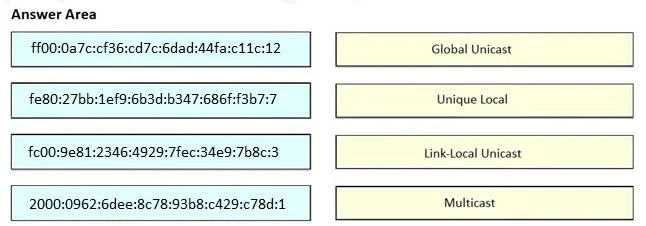
Drag and Drop Question Drag and drop the IPv6 address from the left onto the type on the right. Answer:
The correct answer is 2000:0962:6dee:8c78:93b8:c429:c78d:1; fc00:9e81:2346:4929:7fec:34e9:7b8c:3; fe80:27bb:1ef9:6b3d:b347:686f:f3b7:7; ff00:0a7c:cf36:cd7c:6dad:44fa:c11c:12. IPv6 Address Type Classification The question maps each address to its IPv6 address type based on its prefix (first hextet). The four types in order are: | # | Type | Prefix Range | |---|------|-------------| | 1 | Global Unicast | 2000::/3 (starts with 2 or 3) | | 2 | Unique…
Question
Exhibits
Answer Area
Drag items
Correct arrangement
- 2000:0962:6dee:8c78:93b8:c429:c78d:1
- fc00:9e81:2346:4929:7fec:34e9:7b8c:3
- fe80:27bb:1ef9:6b3d:b347:686f:f3b7:7
- ff00:0a7c:cf36:cd7c:6dad:44fa:c11c:12
Explanation
IPv6 Address Type Classification
The question maps each address to its IPv6 address type based on its prefix (first hextet). The four types in order are:
| # | Type | Prefix Range |
|---|---|---|
| 1 | Global Unicast | 2000::/3 (starts with 2 or 3) |
| 2 | Unique Local | fc00::/7 (starts with fc or fd) |
| 3 | Link-Local | fe80::/10 (starts with fe80 to febf) |
| 4 | Multicast | ff00::/8 (starts with ff) |
Individual Placements
1. 2000:... -> Global Unicast
Starts with 2, which falls in the 2000::/3 block. These are publicly routable addresses - the IPv6 equivalent of public IPv4 addresses. The range covers any address starting with binary 001, i.e., prefixes 2000 to 3fff.
2. fc00:... -> Unique Local
Starts with fc, within the fc00::/7 block (fc00 or fd00 prefixes). These are private, non-routable addresses used inside organizations - analogous to RFC 1918 (10.x, 192.168.x) in IPv4. fc = globally assigned ID (rare); fd = locally generated ID (common).
3. fe80:... -> Link-Local
Starts with fe80, within the fe80::/10 block. These addresses are automatically assigned to every IPv6 interface and are only valid on the local network segment. They are never routed beyond the link. Used for neighbor discovery (NDP) and router advertisements.
4. ff00:... -> Multicast
Starts with ff, which is the ff00::/8 block. All multicast addresses begin with ff. These replace IPv4 broadcast - traffic is sent to all members of a multicast group rather than a single host.
Common Mistakes
- Confusing
fc00(Unique Local) withfe80(Link-Local) - both are private, but link-local is auto-configured per link and never routed; unique local can be routed within an organization. - Thinking
2000::is private - it is public/global. Onlyfc/fdandfe80are private. - Mixing up multicast (
ff) with link-local (fe) -ff= group communication,fe80= single-interface local address. - Assuming
fcandfdare different types - they are both Unique Local; the 8th bit distinguishes locally (fd) vs. globally (fc) assigned IDs, but the type is the same.
Topics
Community Discussion
No community discussion yet for this question.