
200-301 · Question #1318
Drag and Drop Question Drag and drop the characteristic from the left onto the IPv6 address type on the right. Answer:
The correct answer is may be used by multiple organizations at the same time; allows sites to be combined without address conflicts; sends packets to a group address rather than a single address; provides one-to-many communications. The correct arrangement maps characteristics to IPv6 address types as follows: Anycast addresses 'may be used by multiple organizations at the same time' and 'allows sites to be combined without address conflicts' because anycast assigns the same address to multiple interfaces…
Question
Exhibit
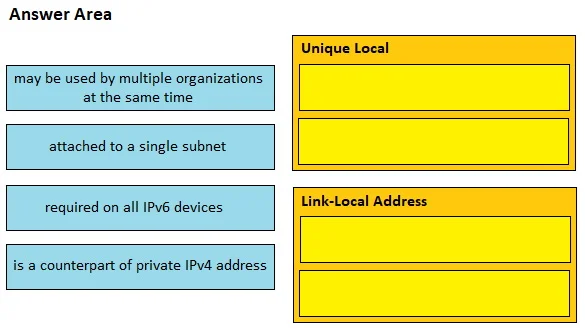
Answer Area
Drag items
Correct arrangement
- may be used by multiple organizations at the same time
- allows sites to be combined without address conflicts
- sends packets to a group address rather than a single address
- provides one-to-many communications
Explanation
The correct arrangement maps characteristics to IPv6 address types as follows: Anycast addresses 'may be used by multiple organizations at the same time' and 'allows sites to be combined without address conflicts' because anycast assigns the same address to multiple interfaces, enabling flexible routing without overlap issues. Multicast addresses 'send packets to a group address rather than a single address' and 'provide one-to-many communications' because multicast delivers a single packet to multiple destinations simultaneously, distinguishing it from unicast (one-to-one) and broadcast. Anycast and multicast are fundamentally different in that anycast delivers to the nearest single node in a group, while multicast delivers to all members of a group.
Topics
Community Discussion
No community discussion yet for this question.