
200-301 · Question #130
Drag and Drop Question A network engineer is configuring an OSPFv2 neighbor adjacency. Drag and drop the parameters from the left onto their required categories on the right. No all parameters are…
The correct answer is must be unique; OSPF process ID; router ID; IP address; must match; netmask; area ID; timers. OSPFv2 Neighbor Adjacency - Parameter Categories The question sorts parameters into two categories: must be unique and must match between neighbors. --- Category 1: Must Be Unique These parameters are locally significant or must be distinct per router - neighbors do not need…
Question
Exhibits
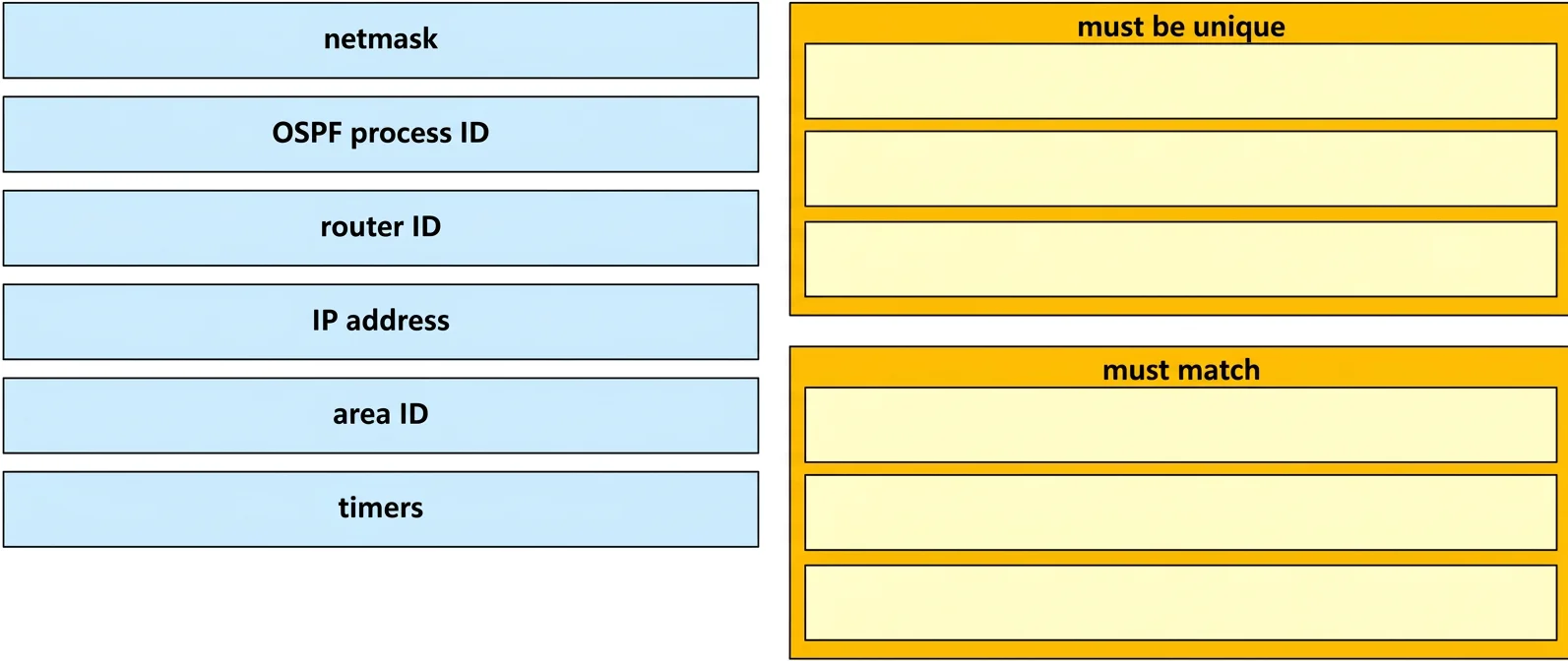
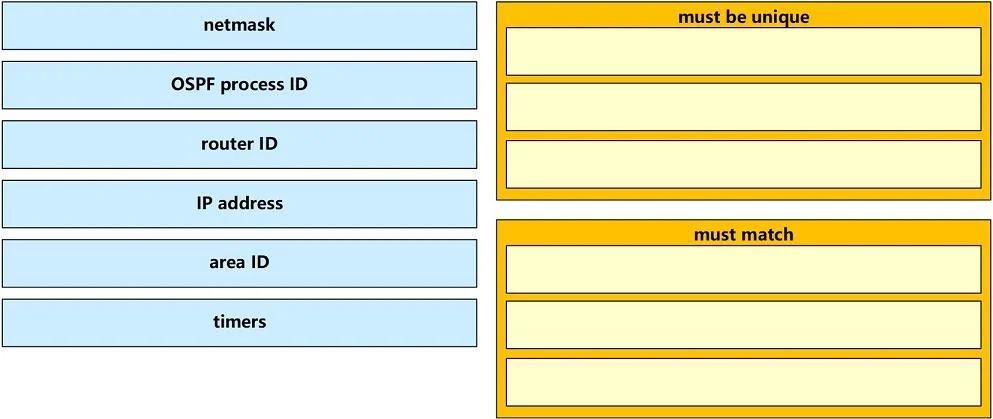
Answer Area
Drag items
Correct arrangement
- must be unique
- OSPF process ID
- router ID
- IP address
- must match
- netmask
- area ID
- timers
Explanation
OSPFv2 Neighbor Adjacency - Parameter Categories
The question sorts parameters into two categories: must be unique and must match between neighbors.
Category 1: Must Be Unique
These parameters are locally significant or must be distinct per router - neighbors do not need matching values.
OSPF Process ID
The process ID (e.g., router ospf 1) is locally significant to the router. Two routers can form a full adjacency even if one uses process ID 1 and the other uses process ID 100. It identifies the OSPF instance on that router only.
Common mistake: Assuming process IDs must match like EIGRP AS numbers. They don't.
Router ID A 32-bit identifier (written in dotted-decimal) that uniquely identifies each router within the OSPF domain. If two routers had the same router ID, the LSDB would be corrupted - SPF calculations depend on unique IDs to build the topology tree.
Common mistake: Confusing router ID with interface IP. The router ID is often the highest loopback IP, but it is a logical identifier, not a routable address per se.
IP Address Each router's interface IP must be unique on the subnet. Without a unique source IP, routing and neighbor discovery via Hello packets would be ambiguous. This is a fundamental IP networking requirement, not OSPF-specific.
Category 2: Must Match
These parameters are checked during Hello exchange. A mismatch prevents adjacency from forming (neighbors stay in Init or 2-Way state, never reaching Full).
Netmask On broadcast and point-to-point networks, both routers must agree on the subnet mask. OSPF includes the interface mask in Hello packets and rejects neighbors with a mismatched mask. This ensures both routers believe they are on the same network segment.
Exception: Unnumbered interfaces and point-to-point links (where mask checks are relaxed).
Area ID Both routers must be configured in the same OSPF area on the connecting interface. Area 0 (backbone) must connect to all other areas. A mismatch here means routers simply won't acknowledge each other as valid OSPF neighbors.
Common mistake: Thinking area type (stub, NSSA) is separate from area ID matching - area type flags are also exchanged in Hellos and must match.
Timers The Hello interval and Dead interval must match. By default these are 10s/40s on broadcast links and 30s/120s on NBMA. If one router sends Hellos every 10s but the neighbor expects 30s, the Dead timer calculation is invalid and adjacency is refused.
Common mistake: Forgetting that changing the Hello timer implicitly changes the Dead timer (Dead = 4Ã- Hello by default) - you may need to adjust both ends manually.
Why "Not All Parameters Are Used"
The question warns that some items are distractors. In this version all six items are placed, but exam variants sometimes include extras like MTU, authentication key, or stub flag - which also must match but are presented as decoys to test whether you know the complete list.
Quick Reference Table
| Parameter | Category | Reason |
|---|---|---|
| OSPF Process ID | Must be unique | Locally significant only |
| Router ID | Must be unique | Unique per router in the domain |
| IP Address | Must be unique | Unique per interface on subnet |
| Netmask | Must match | Validates shared subnet |
| Area ID | Must match | Determines OSPF topology membership |
| Timers | Must match | Hello/Dead intervals synchronized |
Topics
Community Discussion
No community discussion yet for this question.