
200-301 · Question #1144
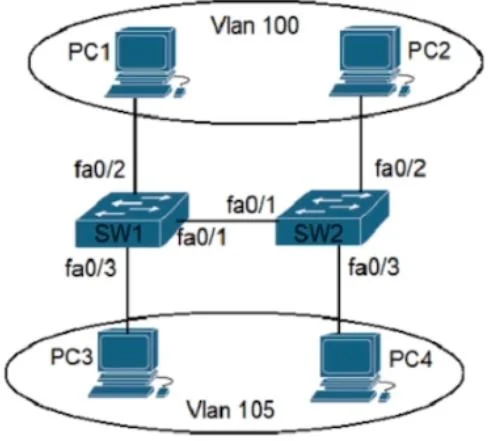
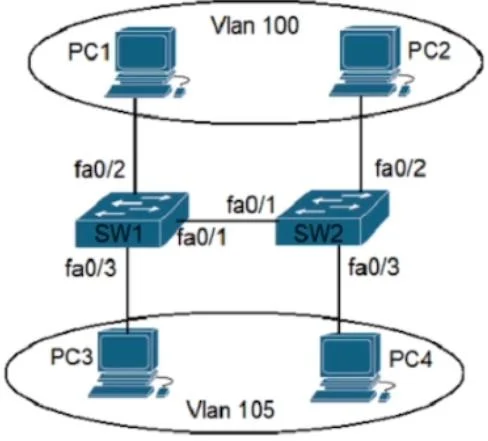
Refer to the exhibit. An engineer configures interface fa0/1 on SW1 and SW2 to pass traffic from two different VLANs. For security reasons, company policy requires the native VLAN to be set to a…
The correct answer is A. Switch(config-if)#switchport mode trunk. To pass traffic from multiple VLANs and set a custom native VLAN, an interface must be configured as a trunk port.
Question
Exhibits
Options
- ASwitch(config-if)#switchport mode trunk
- BSwitch(config-if)#switchport mode trunk
- CSwitch(config-if)#switchport mode dynamic
- DSwitch(config-if)#switchport mode access
How the community answered
(33 responses)- A79% (26)
- B3% (1)
- C6% (2)
- D12% (4)
Why each option
To pass traffic from multiple VLANs and set a custom native VLAN, an interface must be configured as a trunk port.
The `switchport mode trunk` command is necessary to configure the interface as a trunk, allowing it to carry traffic from multiple VLANs. Once in trunk mode, the native VLAN can be explicitly set to a non-default value using `switchport trunk native vlan <vlan-id>`.
This option is identical to A, but it's a duplicate and not the designated correct answer.
The `switchport mode dynamic` command relies on DTP negotiation, which may not always result in a trunk link or allow for consistent native VLAN configuration across different switches.
The `switchport mode access` command configures an interface to carry traffic for only a single VLAN, which fails the requirement to pass traffic from two different VLANs.
Concept tested: Trunk port configuration with native VLAN
Source: https://www.cisco.com/c/en/us/td/docs/switches/lan/catalyst3750/software/release/12-2_55_se/configuration/guide/scg/swtrunks.html
Topics
Community Discussion
No community discussion yet for this question.