
200-301 · Question #1140
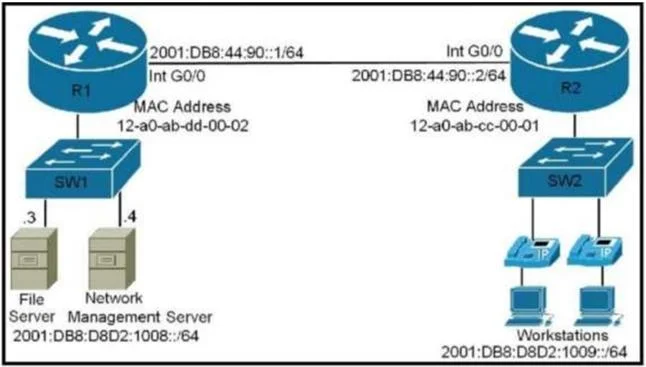
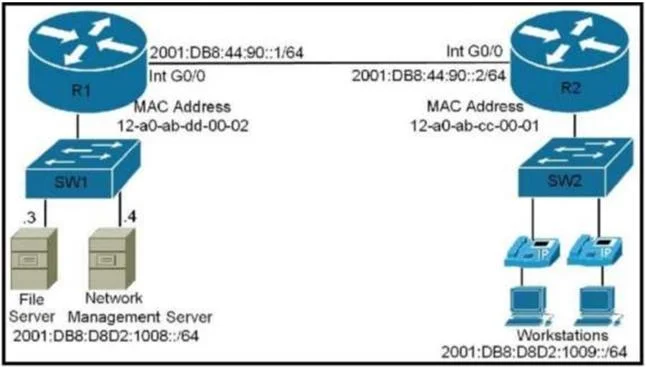
Refer to the exhibit. The iPv6 address for the LAN segment on router R2 must be configured using the EUI-64 format. Which address must be used?
The correct answer is A. ipv6 address 2001:DB8:D8D2:1009:10A0:ABFF:FECC:1 eui-64. The correct IPv6 address using EUI-64 format is derived by taking the interface's MAC address, inserting FFFE in the middle, and flipping the 7th bit of the first byte.
Question
Refer to the exhibit. The iPv6 address for the LAN segment on router R2 must be configured using the EUI-64 format. Which address must be used?
Exhibits
Options
- Aipv6 address 2001:DB8:D8D2:1009:10A0:ABFF:FECC:1 eui-64
- Bipv6 address 2001:DB8:D8D2:1009:1230:ABFF:FECC:1 eui-64
- Cipv6 address 2001:DB8:D8D2:1009:4347:31FF:FF47:0 eui-64
- Dipv6 address 2001:DB8:D8D2:1009:12A0:AB34:FFCC:1 eui-64
How the community answered
(23 responses)- A83% (19)
- B4% (1)
- C9% (2)
- D4% (1)
Why each option
The correct IPv6 address using EUI-64 format is derived by taking the interface's MAC address, inserting FFFE in the middle, and flipping the 7th bit of the first byte.
Assuming R2's interface MAC address begins with `12A0.AB` and ends with `CC.0001`, the EUI-64 process involves splitting `12A0.AB` and `CC.0001`, inserting `FFFE`, and then flipping the 7th bit of the first byte (`12` hex becomes `10` hex) to form `10A0:ABFF:FECC:0001`. Appending this to the given prefix `2001:DB8:D8D2:1009::/64` results in `2001:DB8:D8D2:1009:10A0:ABFF:FECC:1`.
This address's interface identifier `1230:ABFF:FECC:1` does not conform to the EUI-64 derivation rules from a standard MAC address (specifically, the `1230` part and the `1` at the end are inconsistent with common MAC structures).
The interface identifier `4347:31FF:FF47:0` does not align with the EUI-64 formation by inserting FFFE and flipping the 7th bit based on typical MAC address patterns.
The interface identifier `12A0:AB34:FFCC:1` shows `AB34` before `FFCC`, which incorrectly places the `FFFE` insertion, making it inconsistent with the EUI-64 standard.
Concept tested: IPv6 EUI-64 address generation
Source: https://www.cisco.com/c/en/us/support/docs/ip/ipv6/113333-ipv6-eui-64.html
Topics
Community Discussion
No community discussion yet for this question.