
200-150 · Question #10
Refer to the exhibit. Two Layer 2 Cisco Nexus switches are connected to application servers in a data center. Server A cannot communicate with servers that are in VLANs 3 and 4, but t can…
The correct answer is C. A router must be connected to both switches and provide inter VLAN routing. Layer 2 switches cannot route traffic between VLANs; a Layer 3 device such as a router is required to forward packets from one VLAN to another.
Question
Refer to the exhibit. Two Layer 2 Cisco Nexus switches are connected to application servers in a data center. Server A cannot communicate with servers that are in VLANs 3 and 4, but t can communicate with server B and C. What is the cause of the problem?
Exhibit
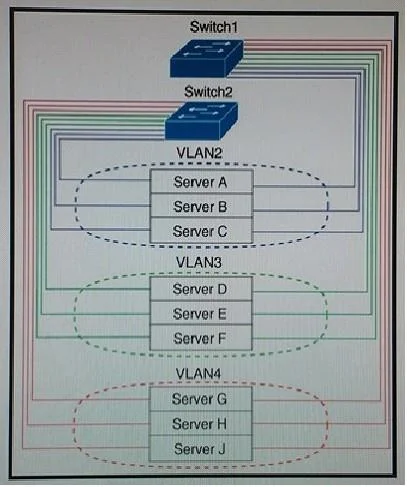
Options
- Ainter VLANs routing is not enabled on both switches
- BSwitch I and switch 2 are not physically connected via an access link.
- CA router must be connected to both switches and provide inter VLAN routing.
- DSwitch 1 and switch 2 not physically connected via a trunk link.
How the community answered
(26 responses)- A8% (2)
- B31% (8)
- C50% (13)
- D12% (3)
Why each option
Layer 2 switches cannot route traffic between VLANs; a Layer 3 device such as a router is required to forward packets from one VLAN to another.
Layer 2 switches do not have inter-VLAN routing capability at all, so the problem is not a configuration setting on the switches but an architectural gap - no routing device exists.
An access link carries traffic for only one VLAN; connecting the switches via an access link would not resolve inter-VLAN routing and is not the described topology issue.
The Nexus switches in the scenario are operating as Layer 2 devices only, which means they forward frames within a VLAN but cannot route IP packets between VLANs 3 and 4. A router (or a switch configured for Layer 3 routing) must be connected to both switches so it can receive traffic from one VLAN, route it, and forward it to the other VLAN - a design commonly called router-on-a-stick or a routed inter-VLAN solution.
A trunk link between the two switches would allow multiple VLANs to traverse the inter-switch link, but Layer 2 trunking alone still cannot route between VLANs - a Layer 3 device is still required.
Concept tested: Inter-VLAN routing requirement for Layer 2 switches
Source: https://www.cisco.com/c/en/us/td/docs/switches/datacenter/nexus9000/sw/7-x/layer2/configuration/guide/b_Cisco_Nexus_9000_Series_NX-OS_Layer_2_Switching_Configuration_Guide_7x.html
Topics
Community Discussion
No community discussion yet for this question.