
200-101 · Question #58
What is the purpose of Inverse ARP?
The correct answer is D. to map a known DLCI to an IP address. In Frame Relay, Inverse ARP (Inverse Address Resolution Protocol) solves the problem of a router knowing its DLCI but not knowing the IP address of the remote peer on that virtual circuit. Regular ARP maps a known IP address to a MAC address (used on Ethernet). Inverse ARP…
Question
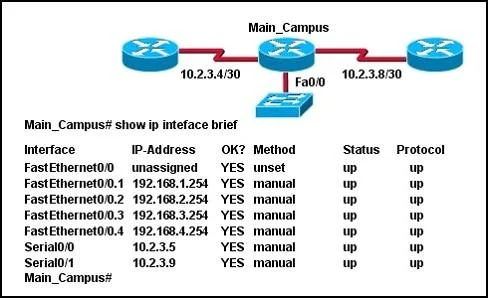
Exhibit
Options
- Ato map a known IP address to a MAC address
- Bto map a known DLCI to a MAC address
- Cto map a known IP address to an IP address
- Dto map a known DLCI to an IP address
- Eto map a known IP address to a SPID
- Fto map a known SPID to a MAC address
How the community answered
(33 responses)- A3% (1)
- C3% (1)
- D94% (31)
Explanation
In Frame Relay, Inverse ARP (Inverse Address Resolution Protocol) solves the problem of a router knowing its DLCI but not knowing the IP address of the remote peer on that virtual circuit. Regular ARP maps a known IP address to a MAC address (used on Ethernet). Inverse ARP works in reverse within the Frame Relay context: given a known DLCI (the Layer 2 identifier), it dynamically discovers the corresponding remote IP address. This allows routers to automatically build their Frame Relay map table without static 'frame-relay map' statements.
Topics
Community Discussion
No community discussion yet for this question.