1Z0-822 · Question #8
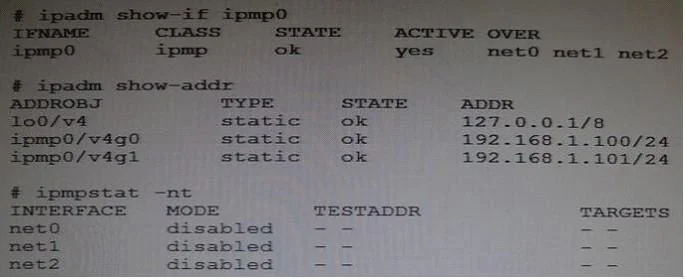
You configured IPMP on the system: Based on this information, select the correct conclusion.
The correct answer is E. The property transitive-probing is false. Disabled in the MODE column means that all probe-based failure detection is disabled. You must enable transitive probing to use this failure detection method that does not require test - display IPMP subsystem status The ipmpstat command concisely displays information about the…
Question
You configured IPMP on the system:
Based on this information, select the correct conclusion.
Exhibit
Options
- ANo default route is configured.
- Bin.mpathd cannot identify failed interfaces.
- CThere are no active interfaces in the group.
- DThere are three standby interfaces in the group.
- EThe property transitive-probing is false.
How the community answered
(32 responses)- A19% (6)
- B3% (1)
- C3% (1)
- D13% (4)
- E63% (20)
Explanation
Disabled in the MODE column means that all probe-based failure detection is disabled. You must enable transitive probing to use this failure detection method that does not require test - display IPMP subsystem status The ipmpstat command concisely displays information about the IPMP subsystem. The -t option identifies the probe targets that are associated with each IP interface in an IPMP group. * Target mode displays IPMP probe target information. The following output fields are supported: The IP interface name associated with the information. The probe target discovery mode: Probe targets found by means of the routing table. Probe targets found by means of multicast ICMP probes. All probe-based failure detection is disabled. Failure detection is by means of transitive probing, where the health of the IP interface is determined by probing other active interfaces in the group. The source address used in outgoing probes. Active interfaces that are being used for data traffic, as well as interfaces that have been explicitly configured with NOFAILOVER test addresses, will have the hostname (or IP address) that is used for sending and receiving the ICMP probes. All other interfaces in the group will display the name of the interface from which the probes are sent. Note that if an active IP interface is configured with both IPv4 and IPv6 test addresses, probe target information will be displayed separately for each test address. A space-separated list of probe target hostnames (or IP addresses) for ICMP probes, or target interfaces for transitive probes. The IP targets will be listed in firing order, and, if no probe targets could be found, this field will be empty.
Topics
Community Discussion
No community discussion yet for this question.
