
1Z0-058 · Question #16
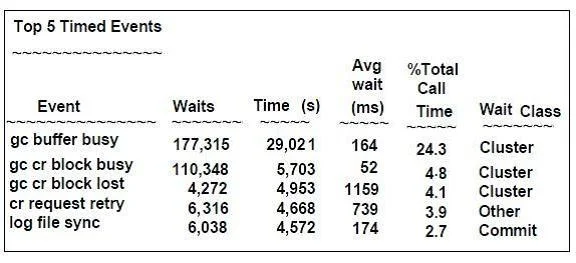
Examine the following details for a six-Instance RAC database: What is the most prominent problem indicated by the above output?
The correct answer is D. misconfigured or faulty interconnect. In Oracle RAC environments, RDBMS gathers global cache work load statistics which are reported in STATSPACK, AWRs and GRID CONTROL. Global cache lost blocks statistics ("gc cr block lost" and/or "gc current block lost") for each node in the cluster as well as aggregate…
Question
Examine the following details for a six-Instance RAC database:
What is the most prominent problem indicated by the above output?
Exhibit
Options
- Ahigh input/output (I/O) delays
- BCPU saturation and memory depletion
- Clarge number of untuned queries from one of the nodes
- Dmisconfigured or faulty interconnect
How the community answered
(39 responses)- A5% (2)
- B3% (1)
- C10% (4)
- D82% (32)
Explanation
In Oracle RAC environments, RDBMS gathers global cache work load statistics which are reported in STATSPACK, AWRs and GRID CONTROL. Global cache lost blocks statistics ("gc cr block lost" and/or "gc current block lost") for each node in the cluster as well as aggregate statistics for the cluster represent a problem or inefficiencies in packet processing for the interconnect traffic. These statistics should be monitored and evaluated regularly to guarantee efficient interconnect Global Cache and Enqueue Service (GCS/GES) and cluster processing. Any block loss indicates a problem in network packet processing and should be investigated. As explained above, Lost blocks are generally caused by unreliable Private network. This can be caused by a bad patch or faulty network configuration or hardware issue. In most cases, gc block lost has been attributed to (a) A missing OS patch (b) Bad network card (c) Bad cable (d) Bad switch (e) One of the network settings. Oracle Metalink "gc block lost diagnostics [ID 563566.1]"
Topics
Community Discussion
No community discussion yet for this question.