
XK0-005 · Question #1601
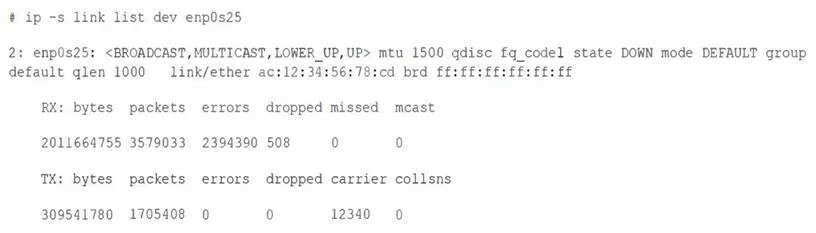
Users are experiencing high latency when accessing a web application served by a Linux machine. A systems administrator checks the network interface counters and sees the following: Which of the…
The correct answer is B. A connection problem exists on the network interface. Elevated error and drop counters on a network interface (such as RX errors, TX errors, collisions, or dropped packets visible in ip -s link or netstat -i) are indicators of a physical or data-link layer problem. Common causes include a duplex mismatch (e.g., one side is…
Question
Exhibit
Options
- AThe network interface is disconnected.
- BA connection problem exists on the network interface.
- CNo IP address is assigned to the interface.
- DThe gateway is unreachable.
How the community answered
(20 responses)- A10% (2)
- B60% (12)
- C5% (1)
- D25% (5)
Explanation
Elevated error and drop counters on a network interface (such as RX errors, TX errors, collisions, or dropped packets visible in ip -s link or netstat -i) are indicators of a physical or data-link layer problem. Common causes include a duplex mismatch (e.g., one side is half-duplex, the other is full-duplex), a degraded cable, a faulty NIC, or a flapping switch port. These conditions cause packet retransmissions and delays, leading to high latency. A disconnected interface (A) would result in complete loss of connectivity, not just latency. No IP address (C) would prevent all traffic, not just slow it down. An unreachable gateway (D) would affect traffic leaving the local subnet, not necessarily produce interface-level error counters.
Topics
Community Discussion
No community discussion yet for this question.