
XK0-005 · Question #1597
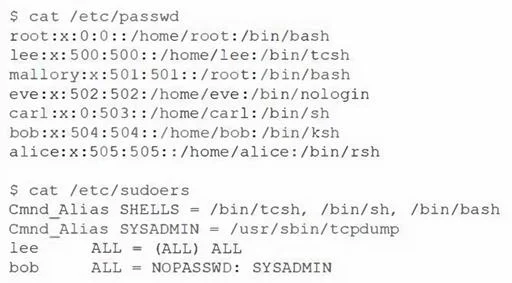
A Linux administrator generated a list of users who have root-level command-line access to the Linux server to meet an audit requirement. The administrator analyzes the following /etc/passwd and…
The correct answer is A. Carl C. Mallory. Root-level access can be granted in two ways: a UID of 0 in /etc/passwd (which grants root privileges regardless of the username), or an entry in /etc/sudoers (or /etc/sudoers.d/) that allows unrestricted sudo access (e.g., ALL=(ALL) ALL or NOPASSWD: ALL). Based on the…
Question
Exhibit
Options
- ACarl
- BLee
- CMallory
- DEve
- EBob
- FAlice
How the community answered
(27 responses)- A63% (17)
- B4% (1)
- D19% (5)
- E11% (3)
- F4% (1)
Explanation
Root-level access can be granted in two ways: a UID of 0 in /etc/passwd (which grants root privileges regardless of the username), or an entry in /etc/sudoers (or /etc/sudoers.d/) that allows unrestricted sudo access (e.g., ALL=(ALL) ALL or NOPASSWD: ALL). Based on the referenced file contents, Carl and Mallory have been identified as holding root-level access through one or both of these mechanisms. The other users (Lee, Eve, Bob, Alice) either have no sudoers entry or have restricted, non-root-equivalent permissions.
Topics
Community Discussion
No community discussion yet for this question.