
SY0-501 · Question #213
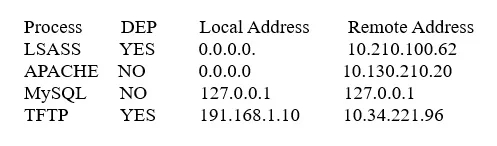
A system administrator is reviewing the following information from a compromised server. Given the above information, which of the following processes was MOST likely exploited via remote buffer…
The correct answer is A. Apache. The question asks to identify which process is most susceptible to a remote buffer overflow attack among the given choices, with Apache being the correct answer.
Question
A system administrator is reviewing the following information from a compromised server. Given the above information, which of the following processes was MOST likely exploited via remote buffer overflow attack?
Exhibit
Options
- AApache
- BLSASS
- CMySQL
- DTFTP
How the community answered
(48 responses)- A83% (40)
- B6% (3)
- C8% (4)
- D2% (1)
Why each option
The question asks to identify which process is most susceptible to a remote buffer overflow attack among the given choices, with Apache being the correct answer.
Apache, as a widely deployed web server, constantly processes untrusted remote input via HTTP requests, making it a prime target for remote buffer overflow vulnerabilities in its input parsing and handling mechanisms. These vulnerabilities can allow attackers to execute arbitrary code remotely by sending specially crafted requests that exceed expected buffer sizes.
LSASS is a critical Windows operating system process primarily responsible for local security policies and user authentication, and while it has been targeted by exploits, a direct *remote buffer overflow* attack against LSASS itself is less common as an initial entry point compared to network-facing services.
MySQL is a database server; while it handles network connections and can have vulnerabilities, remote buffer overflows are more frequently associated with the application layer (like web servers) that handle the initial parsing of diverse and complex network requests before data reaches the database.
TFTP is a simple file transfer protocol that has historically had buffer overflow vulnerabilities, but its limited functionality and less ubiquitous exposure compared to a full-fledged web server like Apache make it a less *likely* primary target for widespread remote buffer overflow exploitation in a general context.
Concept tested: Identifying common remote exploitation targets and attack vectors
Source: https://learn.microsoft.com/en-us/windows/win32/secbp/buffer-overruns
Topics
Community Discussion
No community discussion yet for this question.