
SY0-301 · Question #387
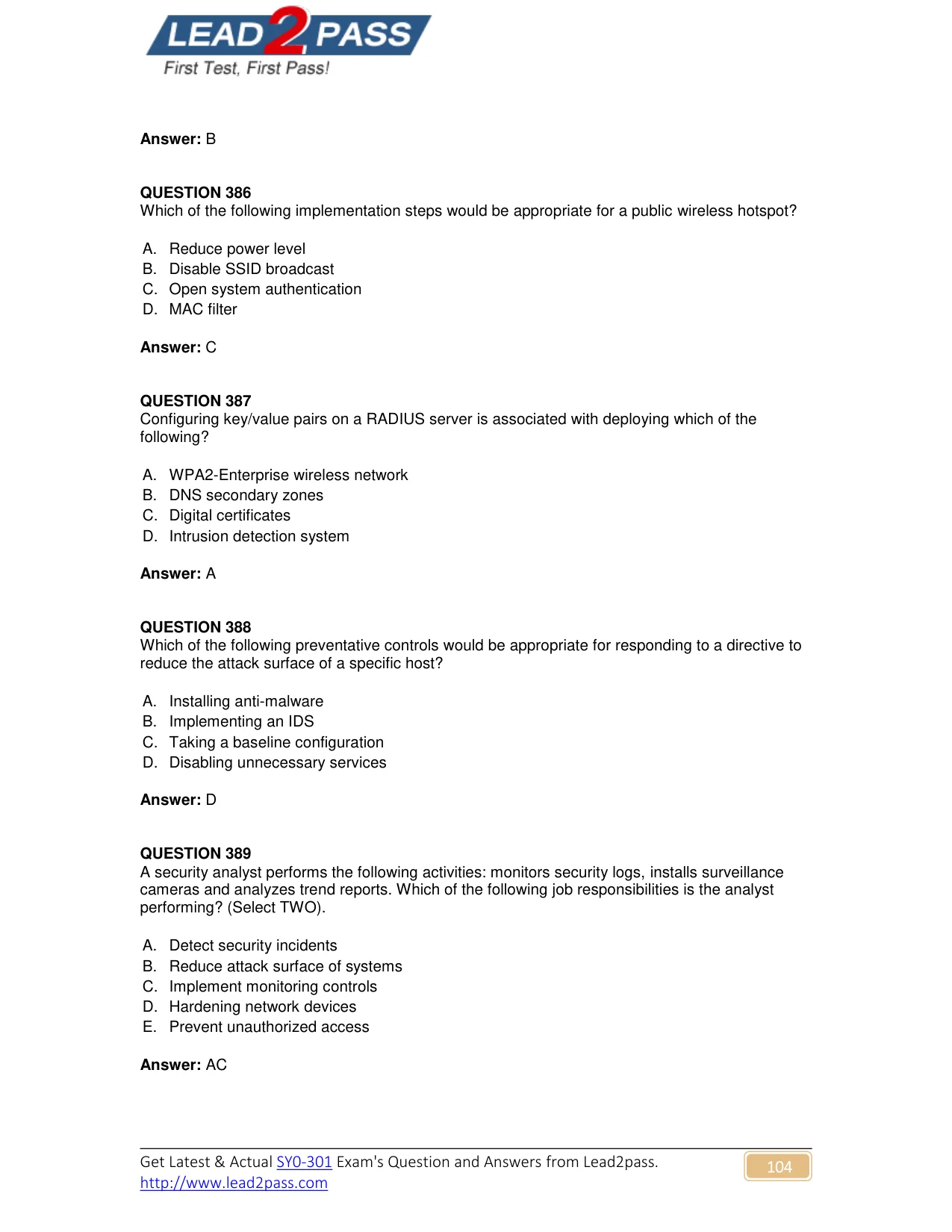
Configuring key/value pairs on a RADIUS server is associated with deploying which of the following?
The correct answer is A. WPA2-Enterprise wireless network. RADIUS uses attribute-value pairs to authenticate and authorize users in WPA2-Enterprise 802.1X wireless network deployments.
Question
Configuring key/value pairs on a RADIUS server is associated with deploying which of the following?
Exhibit
Options
- AWPA2-Enterprise wireless network
- BDNS secondary zones
- CDigital certificates
- DIntrusion detection system
How the community answered
(34 responses)- A88% (30)
- B3% (1)
- C3% (1)
- D6% (2)
Why each option
RADIUS uses attribute-value pairs to authenticate and authorize users in WPA2-Enterprise 802.1X wireless network deployments.
WPA2-Enterprise relies on the 802.1X authentication framework, which uses a RADIUS server as the AAA (Authentication, Authorization, and Accounting) backend. RADIUS communicates using attribute-value pairs - also called key/value pairs - to convey authentication data such as usernames, passwords, VLAN assignments, and session policies between the wireless access point and the authentication server. Configuring these pairs on the RADIUS server is a standard and required step in deploying WPA2-Enterprise.
DNS secondary zones are configured on DNS servers to provide zone redundancy and have no relationship to RADIUS servers or key/value pair configuration.
Digital certificates are issued and managed by a Certificate Authority within a PKI infrastructure, not configured through RADIUS attribute-value pairs.
Intrusion detection systems are configured to analyze network traffic and event signatures for threats and are not deployed or configured via RADIUS.
Concept tested: RADIUS attribute-value pairs for WPA2-Enterprise 802.1X
Source: https://learn.microsoft.com/en-us/windows-server/networking/technologies/nps/nps-radius-technical-reference
Topics
Community Discussion
No community discussion yet for this question.