
SK0-005 · Question #471
A technician is setting up a repurposed server. The minimum requirements are 2TB while ensuring the highest performance and providing support for one drive failure. The technician has the following…
The correct answer is C. 1, 2, 4, 5, and 6. RAID 5 configuration: Using five of the available drives in a RAID 5 configuration meets the requirements for: Storage capacity: Four 600GB drives (2, 5, and 6) provide a total usable capacity of 2.4TB (4 600 0.8), exceeding the minimum requirement of 2TB. RAID 5 introduces…
Question
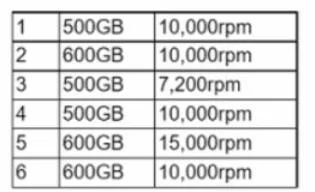
A technician is setting up a repurposed server. The minimum requirements are 2TB while ensuring the highest performance and providing support for one drive failure. The technician has the following six drives available:
Which of the following drive selections should the technician utilize to best accomplish this goal?
Exhibit
Options
- A1,2, 4, and 6
- B1, 2, 3, 5, and 6
- C1, 2, 4, 5, and 6
- D1, 2, 3, 4, and 6
How the community answered
(20 responses)- A5% (1)
- B5% (1)
- C75% (15)
- D15% (3)
Explanation
RAID 5 configuration: Using five of the available drives in a RAID 5 configuration meets the requirements for: Storage capacity: Four 600GB drives (2, 5, and 6) provide a total usable capacity of 2.4TB (4 * 600 * 0.8), exceeding the minimum requirement of 2TB. RAID 5 introduces parity data for fault tolerance, sacrificing some usable space (one drive's worth). Performance: The combination of multiple drives in a RAID 5 array improves read performance compared to a single drive setup. Fault tolerance: Even with a single drive failure (any of the five drives used in the RAID 5), the remaining drives can reconstruct the lost data, allowing the server to continue operating.
Topics
Community Discussion
No community discussion yet for this question.