
SCS-C02 · Question #143
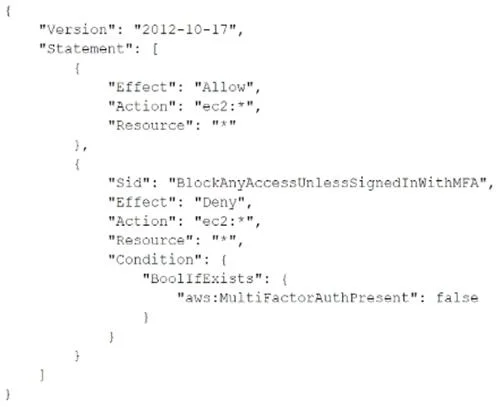
An AWS account administrator created an IAM group and applied the following managed policy to require that each individual user authenticate using multi-factor authentication: After implementing the…
The correct answer is B. Instruct users to run the aws sts get-session-token CLI command and pass the multi-factor. When the IAM policy includes a condition like aws:MultiFactorAuthPresent: true, long-term access key credentials used directly by the CLI do not satisfy this condition - the CLI call fails because no MFA context is attached. Running aws sts get-session-token --serial-number…
Question
An AWS account administrator created an IAM group and applied the following managed policy to require that each individual user authenticate using multi-factor authentication:
After implementing the policy, the administrator receives reports that users are unable to perform Amazon EC2 commands using the AWS CLI. What should the administrator do to resolve this problem while still enforcing multi-factor authentication?
Exhibit
Options
- AChange the value of aws:MultiFactorAuthPresent to true.
- BInstruct users to run the aws sts get-session-token CLI command and pass the multi-factor
- CImplement federated API/CLI access using SAML 2.0, then configure the identity provider to
- DCreate a role and enforce multi-factor authentication in the role trust policy. Instruct users to run
How the community answered
(25 responses)- A8% (2)
- B72% (18)
- C16% (4)
- D4% (1)
Explanation
When the IAM policy includes a condition like aws:MultiFactorAuthPresent: true, long-term access key credentials used directly by the CLI do not satisfy this condition - the CLI call fails because no MFA context is attached. Running aws sts get-session-token --serial-number <mfa-arn> --token-code <code> generates temporary session credentials that do carry the MFA context, satisfying the policy condition and restoring EC2 access.
Why the distractors are wrong:
- A is wrong because the policy already requires MFA (
true); changing the condition value doesn't fix the root problem - users simply aren't presenting MFA-backed credentials via the CLI. - C is wrong because SAML 2.0 federation is a heavyweight solution for a different use case (SSO/enterprise identity); it doesn't directly solve the CLI MFA problem and introduces unnecessary complexity.
- D is wrong (or at least suboptimal) because role assumption with MFA in the trust policy is a valid but more complex architecture - it requires creating and maintaining a role, whereas
get-session-tokensolves the problem with no structural changes.
Memory tip: Think of sts get-session-token as the CLI's MFA badge scanner - you swipe your MFA code once to get a temporary badge (session token) that proves you authenticated with MFA, which the policy then accepts.
Topics
Community Discussion
No community discussion yet for this question.