
SCS-C02 · Question #291
An company is using AWS Secrets Manager to store secrets that are encrypted using a CMK and are stored in the security account 111122223333. One of the company's production accounts. 444455556666…
The correct answer is A. Option A. > Note: The actual policy text for Options A–D wasn't included in your question - only labels were provided. The explanation below is based on the established AWS best practices this question is testing. Option A is correct because a least-privilege resource-based policy on the…
Question
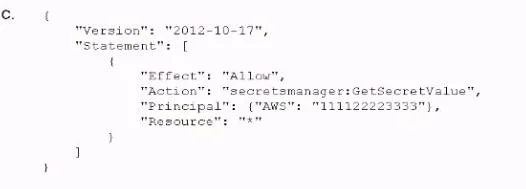
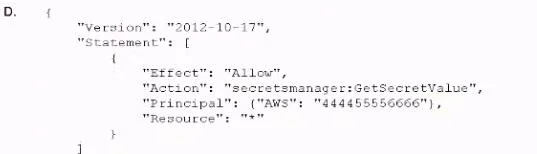
An company is using AWS Secrets Manager to store secrets that are encrypted using a CMK and are stored in the security account 111122223333. One of the company's production accounts. 444455556666, must to retrieve the secret values from the security account 111122223333. A security engineer needs to apply a policy to the secret in the security account based on least privilege access so the production account can retrieve the secret value only. Which policy should the security engineer apply?
Exhibits
Options
- AOption A
- BOption B
- COption C
- DOption D
How the community answered
(48 responses)- A81% (39)
- B4% (2)
- C4% (2)
- D10% (5)
Explanation
Note: The actual policy text for Options A–D wasn't included in your question - only labels were provided. The explanation below is based on the established AWS best practices this question is testing.
Option A is correct because a least-privilege resource-based policy on the secret should grant only secretsmanager:GetSecretValue to the principal arn:aws:iam::444455556666:root (the production account), allowing cross-account retrieval without exposing administrative actions like PutSecretValue, DeleteSecret, or RotateSecret. The distractors typically fail by either granting overly broad permissions (e.g., secretsmanager:*), using the wrong principal (e.g., the security account itself or a wildcard *), or specifying an IAM identity policy instead of a resource-based policy on the secret - which is required for cross-account access since IAM identity policies alone cannot grant cross-account Secrets Manager access. Remember that with a CMK-encrypted secret, you also need a corresponding KMS key policy allowing the production account to use the key, but that is a separate step from the secret policy itself.
Memory tip: Think "secret policy + key policy = cross-account access." The secret's resource policy grants GetSecretValue to the external account; the KMS key policy grants kms:Decrypt. Both must be in place - missing either one breaks the chain.
Topics
Community Discussion
No community discussion yet for this question.