
PT0-002 · Question #283
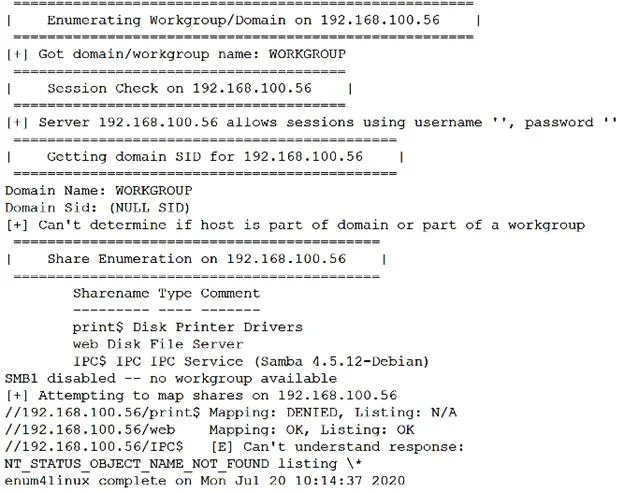
After running the enum4linux.pl command, a penetration tester received the following output: Which of the following commands should the penetration tester run NEXT?
The correct answer is C. smbget //192.168.100.56/web -U ''. enum4linux is a tool for enumerating SMB/Windows information from Linux systems, commonly revealing available shares, user lists, and access permissions. The output (though not shown in text) would typically display shares available on the target host, including one named 'web'…
Question
After running the enum4linux.pl command, a penetration tester received the following output:
Which of the following commands should the penetration tester run NEXT?
Exhibit
Options
- Asmbspool //192.160.100.56/print$
- Bnet rpc share -S 192.168.100.56 -U ''
- Csmbget //192.168.100.56/web -U ''
- Dsmbclient //192.168.100.56/web -U '' -N
How the community answered
(37 responses)- A11% (4)
- B3% (1)
- C78% (29)
- D8% (3)
Explanation
enum4linux is a tool for enumerating SMB/Windows information from Linux systems, commonly revealing available shares, user lists, and access permissions. The output (though not shown in text) would typically display shares available on the target host, including one named 'web' accessible anonymously. The logical next step after discovering an anonymously accessible SMB share is to retrieve its contents. 'smbget' is the SMB equivalent of wget - it downloads files recursively from an SMB share. The command 'smbget //192.168.100.56/web -U ''' attempts to download files from the 'web' share using empty (anonymous) credentials. Option A has a typo in the IP (192.160.100.56 vs 192.168.100.56), making it invalid. Option B (net rpc share) is a Windows-style command for listing shares, a step already completed. Option D (smbclient) launches an interactive file browser session - useful for exploration but 'smbget' is more efficient for directly retrieving files from a discovered share.
Topics
Community Discussion
No community discussion yet for this question.