
PT0-002 · Question #161
A penetration tester is attempting to discover live hosts on a subnet quickly. Which of the following commands will perform a ping scan?
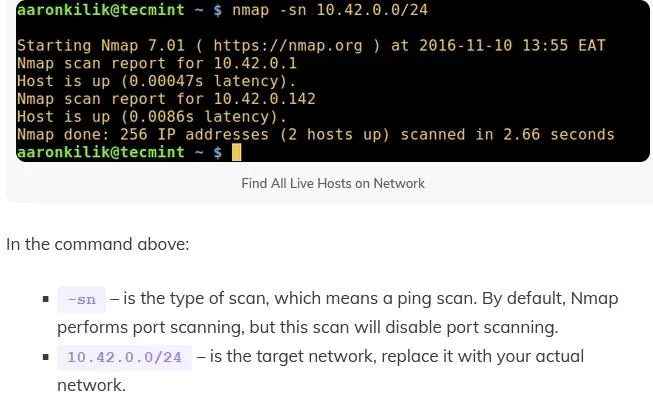
The correct answer is A. nmap -sn 10.12.1.0/24. To quickly discover live hosts on a subnet, a penetration tester should use the Nmap ping scan command. This type of scan identifies active devices without performing port scans, making it fast and efficient for host discovery.
Question
A penetration tester is attempting to discover live hosts on a subnet quickly. Which of the following commands will perform a ping scan?
Exhibit
Options
- Anmap -sn 10.12.1.0/24
- Bnmap -sV -A 10.12.1.0/24
- Dnmap -sT -p- 10.12.1.0/24
How the community answered
(59 responses)- A88% (52)
- B8% (5)
- D3% (2)
Why each option
To quickly discover live hosts on a subnet, a penetration tester should use the Nmap ping scan command. This type of scan identifies active devices without performing port scans, making it fast and efficient for host discovery.
The nmap -sn command performs a "no port scan" or "ping scan" operation, which is designed to quickly discover live hosts on a network by sending ICMP echo requests, TCP SYN packets to common ports, or ARP requests, without performing a full port scan on each host. This method is effective for identifying which hosts are online within a specified subnet range.
The nmap -sV -A command performs version detection (-sV) and aggressive scanning (-A), including OS detection, version detection, script scanning, and traceroute, which is a comprehensive and time-consuming scan, not a quick ping scan for host discovery.
The nmap -sT -p- command performs a full TCP connect scan (-sT) across all 65535 ports (-p-), which is a very intrusive and time-consuming port scan, not a quick ping scan for host discovery.
Concept tested: Nmap host discovery ping scan
Source: https://nmap.org/book/man-host-discovery.html
Topics
Community Discussion
No community discussion yet for this question.