
PROFESSIONAL-DATA-ENGINEER · Question #289
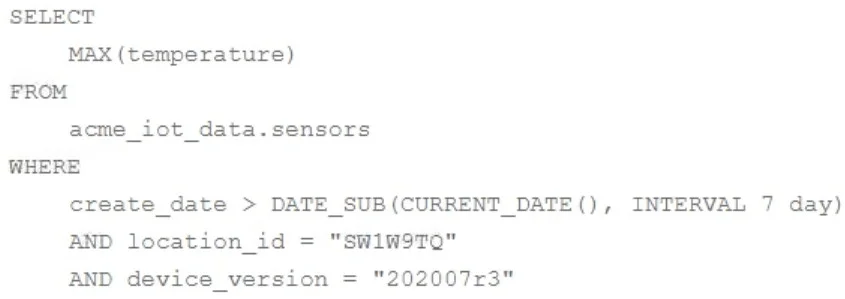
You are collecting IoT sensor data from millions of devices across the world and storing the data in BigQuery. Your access pattern is based on recent data, filtered by location_id and device_version…
The correct answer is B. Partition table data by create_date, cluster table data by location_id, and device_version. Option B is correct because BigQuery only supports partitioning on a single column, and create_date (a time-based field) is the ideal partition key since it enables partition pruning on the most selective filter - recent data. Clustering on location_id and device_version then…
Question
Exhibit
Options
- APartition table data by create_date, location_id, and device_version.
- BPartition table data by create_date, cluster table data by location_id, and device_version.
- CCluster table data by create_date, location_id, and device_version.
- DCluster table data by create_date, partition by location_id, and device_version.
How the community answered
(48 responses)- A6% (3)
- B81% (39)
- C10% (5)
- D2% (1)
Explanation
Option B is correct because BigQuery only supports partitioning on a single column, and create_date (a time-based field) is the ideal partition key since it enables partition pruning on the most selective filter - recent data. Clustering on location_id and device_version then further narrows data scanned within each partition, reducing cost and improving performance.
Why the distractors fail:
- A is invalid - BigQuery does not support multi-column partitioning; you can only partition on one column.
- C skips partitioning entirely, which means BigQuery cannot prune whole partitions of old data before applying clustering, losing the biggest cost/performance win.
- D reverses the relationship - you cannot cluster by a date column and then partition by two other columns; partitioning is limited to one column and clustering follows partitioning, not the other way around.
Memory tip: Think "Partition first, cluster second" - partition on your primary time/range filter (one column only), then cluster on the next 1–4 columns your WHERE clause filters. This matches the "coarse filter → fine filter" pattern BigQuery uses internally.
Topics
Community Discussion
No community discussion yet for this question.