
PL-300 · Question #98
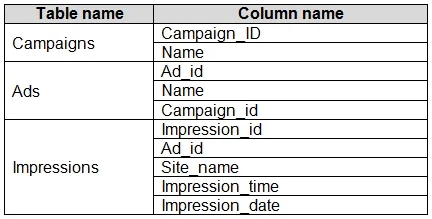
You have the tables shown in the following table. The Impressions table contains approximately 30 million records per month. You need to create an ad analytics system to meet the following…
The correct answer is B. Create one-to-many relationships between the tables. C. Create a calculated measure that aggregates by using the COUNTROWS function. To minimize data model size and create an ad analytics system, establish one-to-many relationships for efficient data querying and use calculated measures for dynamic aggregation of impression counts.
Question
You have the tables shown in the following table. The Impressions table contains approximately 30 million records per month. You need to create an ad analytics system to meet the following requirements:
- Present ad impression counts for the day, campaign, and Site_name.
The analytics for the last year are required.
- Minimize the data model size.
Which two actions should you perform? Each correct answer presents part of the solution. NOTE: Each correct selection is worth one point.
Exhibit
Options
- AGroup the impressions by Ad_id, Site_name, and Impression_date.
- BCreate one-to-many relationships between the tables.
- CCreate a calculated measure that aggregates by using the COUNTROWS function.
- DCreate a calculated table that contains Ad_id, Site_name, and Impression_date.
How the community answered
(51 responses)- A10% (5)
- B84% (43)
- D6% (3)
Why each option
To minimize data model size and create an ad analytics system, establish one-to-many relationships for efficient data querying and use calculated measures for dynamic aggregation of impression counts.
Grouping impressions into a new table or changing the grain of the fact table explicitly would either increase the data model size (if it's a new table) or reduce the granularity of the original data, which might not be desired for flexible analysis.
Creating one-to-many relationships establishes a star schema, which is crucial for efficient data modeling, reduced redundancy, and optimized query performance, thereby helping to minimize the data model size by linking dimension tables to a compact fact table.
Creating a calculated measure using functions like COUNTROWS aggregates data on-the-fly during query execution, which significantly minimizes data model size compared to storing pre-calculated results in calculated columns or tables.
Creating a calculated table containing these columns would increase the data model size by duplicating or storing summarized data, directly contradicting the requirement to minimize model size.
Concept tested: Data modeling for performance and size, DAX measures
Source: https://learn.microsoft.com/en-us/power-bi/guidance/star-schema, https://learn.microsoft.com/en-us/power-bi/guidance/dax-measures
Topics
Community Discussion
No community discussion yet for this question.