
PL-300 · Question #477
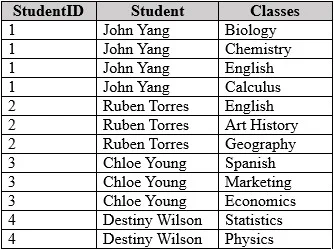
You have a query in Power Query Editor that contains the following data. You need to transform the data to appear as shown in the following table. What should you do?
The correct answer is A. Split the Classes column into rows by using a delimiter. Power Query, Split columns by delimiter Split columns by delimiter into rows In this example, your initial table is shown in the following image, with the columns Cost Center The Accounts column has values in pairs separated by a comma. These pairs are separated by a semicolon…
Question
You have a query in Power Query Editor that contains the following data. You need to transform the data to appear as shown in the following table. What should you do?
Exhibit
Options
- ASplit the Classes column into rows by using a delimiter.
- BUnpivot the Classes column.
- CExtract the text between delimiters in the Classes column.
- DConvert the Classes column into a list.
How the community answered
(34 responses)- A79% (27)
- B3% (1)
- C12% (4)
- D6% (2)
Explanation
Power Query, Split columns by delimiter Split columns by delimiter into rows In this example, your initial table is shown in the following image, with the columns Cost Center The Accounts column has values in pairs separated by a comma. These pairs are separated by a semicolon. The goal of this example is to split this column into new rows by using the semicolon as the delimiter. In this example using Power Query Online, you want to split this column into two columns. A space character delimits the values-the first space from left to right. To do this split, select the column, and then select the option to split the column by a delimiter. In Split Column by Delimiter, apply the following configuration: Basic/Advanced: Advanced Select or enter delimiter: Space Split at: Left-most delimiter Split into: Columns The result of that operation gives you a table with the same number of columns, but many more rows because the values inside the cells are now in their own cells. https://learn.microsoft.com/en-us/power-query/split-columns-delimiter
Community Discussion
No community discussion yet for this question.